
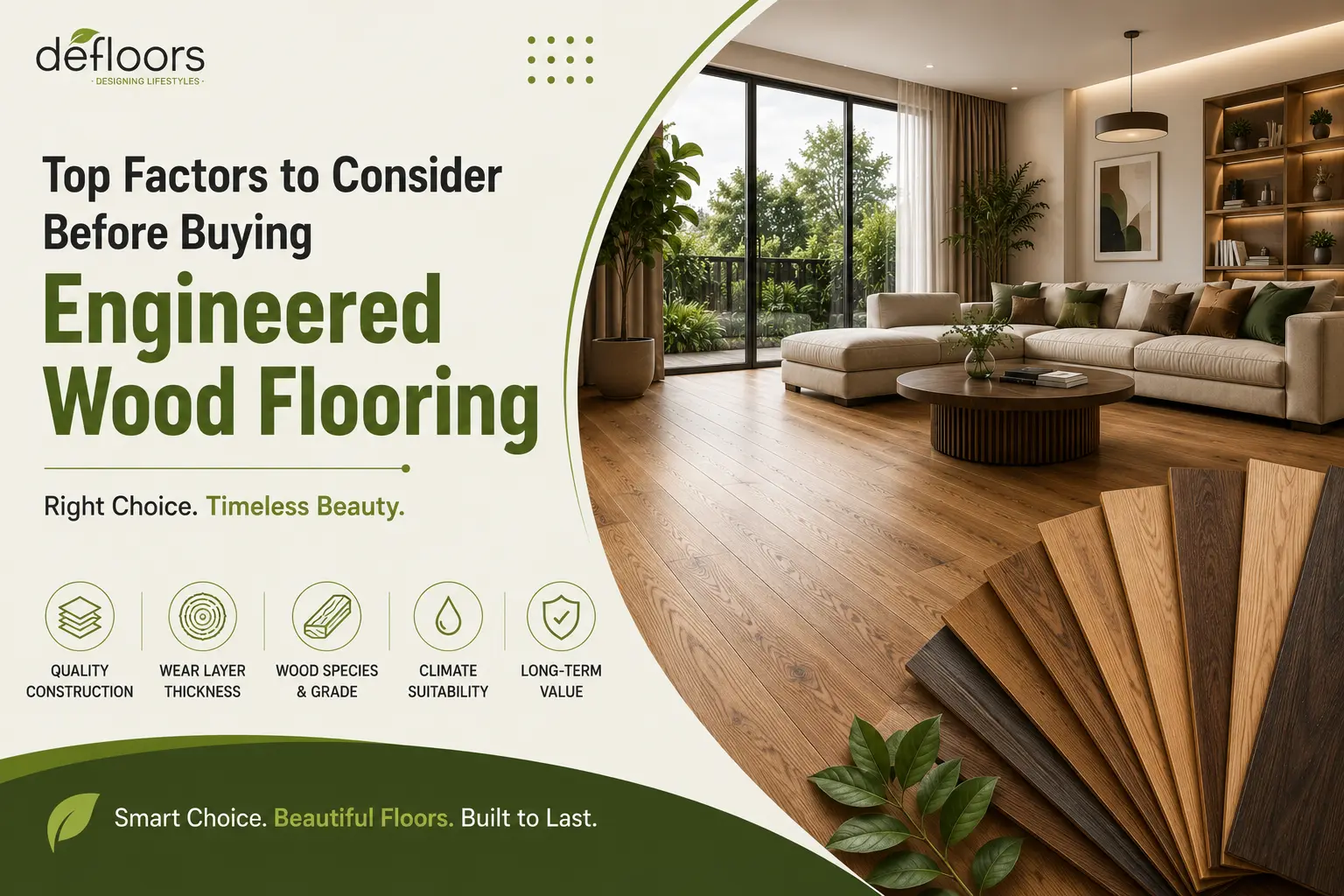
Buying engineered wood flooring is not simply a matter of choosing a colour or selecting the most attractive plank in a showroom. It is a long-term flooring decision that can influence the comfort, appearance, maintenance, and overall character of your property for years.
The challenge is that engineered wood flooring can look deceptively simple from the surface. Two floors may both appear to have a beautiful natural oak finish, yet their construction, hardwood veneer, core, dimensions, finish, stability, installation requirements, and expected performance can be quite different.
This matters even more in India.
A flooring system installed in a Delhi NCR home may experience intense summer temperatures, monsoon humidity, dry winters, air conditioning, dust, changing indoor conditions, and different subfloor environments. The product therefore needs to be evaluated according to where and how it will actually be used, not simply how it looks in a sample.
Defloors’ engineered wood flooring collections are designed around this balance of natural aesthetics and structural performance. The range includes high-quality wood species such as Oak and Walnut, with products featuring multi-layered construction and overall thicknesses in the 14–15 mm range on the main engineered collection page.
So, what should you actually check before buying?
From construction and wear layer thickness to climate suitability, installation, maintenance, cost, and supplier expertise, this guide explains the factors that deserve your attention before making the final decision.
What Should You Check Before Buying Engineered Wood Flooring?
Before purchasing engineered wood flooring, evaluate the product, the property, and the supplier together.
The most important factors include:
- Construction and core quality
- Hardwood veneer or wear layer
- Wood species and grade
- Overall flooring thickness
- Plank dimensions
- Surface finish
- Flooring pattern and design
- Climate suitability
- Moisture and water-resistance characteristics
- Subfloor compatibility
- Installation method
- Maintenance requirements
- Long-term value and engineered wood flooring cost
- Supplier expertise and installation support
A product that performs well across these areas is much more likely to provide the combination of aesthetics, stability, and longevity you expect from premium flooring.
You may read this: Complete Guide to Engineered Wood Flooring
Understand the Construction Before Comparing Products
The first thing to examine is what is actually inside the plank.
Engineered flooring is a multi-layered real-wood flooring solution. Unlike solid wood, which is milled from a single piece of timber, engineered flooring combines a genuine hardwood top layer with a structurally engineered base.
Defloors‘ engineered range includes 3-layer and multi-layer constructions, using engineered hardwood or softwood bases depending on the product. The company’s broader engineered flooring page specifies 14–15 mm multi-layered construction for its collection.
This construction is not simply about making the product different from solid wood.
Its primary purpose is to improve stability.
Read more: Engineered Wood Flooring vs Solid Wood Flooring
Why Does Multi-Layer Construction Matter?
Natural timber responds to changes in moisture and temperature.
When environmental conditions change, wood can naturally expand or contract. A carefully engineered multi-layer structure helps counteract this movement by arranging layers in a way that improves dimensional stability.
Defloors specifically highlights cross-lamination as a factor that reduces expansion and contraction associated with humidity and temperature changes.
That makes construction one of the most important engineered wood flooring specifications to understand before buying.
3-Layer vs Multi-Layer Construction
You may encounter both 3-layer and multi-layer engineered flooring.
The number of layers alone does not determine whether one product is automatically superior.
What matters is:
- What each layer is made from
- How the layers are constructed
- The quality of the adhesive
- The thickness of the hardwood surface
- The overall structural integrity
Therefore, don’t simply ask:
“How many layers does it have?”
Ask:
“What are the layers made of, and how does the construction contribute to stability and longevity?”
That is a much more useful quality question.
Evaluate the Wood Species and Natural Character
Once you understand the construction, look at the wood itself.
The visible hardwood layer is what gives engineered flooring its natural appearance, texture, grain, and character.
Defloors’ engineered collection includes species such as Oak and Walnut, giving homeowners and designers different aesthetic directions to work with.
Oak Engineered Wood Flooring
Oak remains one of the most versatile choices for residential interiors.
Its characteristic grain and natural tonal variation work across a wide range of design styles, from contemporary apartments to more traditional luxury residences.
Oak can be particularly suitable when you want flooring that remains visually relevant even as furniture, wall colours, and interior trends change.
Walnut Engineered Wood Flooring
Walnut offers a richer and more dramatic visual character.
Its deeper tones can create an atmosphere of:
- Luxury
- Warmth
- Sophistication
- Visual depth
It can work especially well in premium interiors where flooring is intended to become an important design element rather than simply a background surface.
Don’t Choose Species in Isolation
The same wood species can look completely different depending on:
- Grade
- Grain orientation
- Stain
- Surface finish
- Plank width
- Natural light
Therefore, always evaluate a flooring sample in the context of your actual interior.
A colour that looks perfect under showroom lighting may behave differently beside your walls, furniture, and natural daylight.
Check the Veneer or Wear Layer Thickness
This is one of the most important factors to evaluate when buying engineered flooring.
The visible hardwood portion is commonly referred to as the veneer, wear layer, or hardwood top layer, depending on the product and terminology used by the manufacturer.
Its thickness matters because it influences the amount of genuine hardwood available above the engineered core.
Defloors’ product information notes that engineered wood veneer thickness can vary by product grade, with thicker veneers generally offering greater durability and refinishing potential.
Why Does Wear Layer Thickness Matter?
A thicker hardwood layer can provide advantages in terms of:
- Long-term durability
- Restoration potential
- Surface longevity
- Premium feel
- Future refinishing possibilities
However, thickness should never be evaluated independently.
A flooring product with a thicker veneer is not automatically the best choice for every project.
You should also consider the core construction, finish, installation, expected traffic, and overall product quality.
Ask This Question Before Buying
Instead of simply asking for the flooring’s total thickness, ask:
“How thick is the genuine hardwood top layer?”
That distinction is critical.
A 14 mm or 15 mm floor does not mean that the entire 14–15 mm consists of hardwood.
The total thickness and hardwood wear layer are two different specifications.
Look at the Core Construction, Not Just the Surface
A beautiful showroom sample tells you very little about what happens underneath.
The core is one of the reasons engineered flooring can provide greater dimensional stability than conventional solid wood.
Defloors states that its engineered products use engineered hardwood or softwood bases, while its detailed product information also references multi-ply hardwood, HDF, and premium plywood core constructions across its range.
What Makes a Good Core Important?
The core contributes to:
- Structural stability
- Dimensional performance
- Resistance to environmental movement
- Overall plank integrity
For Indian homes, this becomes especially relevant because environmental conditions can change considerably throughout the year.
Don’t Compare Products Solely by Appearance
Two engineered floors can have almost identical colours and textures while using different internal constructions.
That is why technical specifications should be part of your buying conversation.
If a supplier can explain the core construction clearly, including what the layers are made from and why they were selected, that is a much stronger buying signal than simply being shown attractive samples.
Consider Overall Thickness and Plank Dimensions
Overall flooring thickness is another specification worth understanding.
Defloors’ detailed engineered flooring information places its standard range around 12–15 mm, while its primary engineered collection page highlights 14–15 mm multi-layered construction.
However, thickness alone should never be used as a shortcut for judging quality.
You need to consider it alongside the hardwood layer and core.
Plank Width Matters Too
Wide planks have become particularly popular in premium interiors because they can create a more expansive and visually continuous floor.
They can work exceptionally well in:
- Large living rooms
- Open-plan residences
- Luxury villas
- Premium apartments
Narrower formats may be more appropriate where the room dimensions, design language, or installation requirements call for greater visual rhythm.
Plank Length Matters
Longer planks can create a cleaner visual flow by reducing the number of visible joints.
However, the ideal dimensions depend on:
- Room proportions
- Furniture layout
- Interior architecture
- Installation conditions
There is no universally “best” plank size.
The correct size is the one that works with the space rather than against it.
Choose the Right Flooring Pattern and Design
Engineered wood flooring is no longer limited to conventional straight-plank layouts.
Patterned flooring has become an important part of premium interior design, particularly for homeowners and designers looking to make the floor a visual feature.
Defloors’ engineered collection range includes Herringbone, Lodge/Chevron, Prime Parket, and Multi Layer collections.
Straight-Plank Flooring
Straight-plank flooring remains the most versatile option.
It works particularly well when the objective is:
- Clean visual lines
- Timeless design
- Minimalist interiors
- A spacious appearance
Herringbone Flooring
Herringbone introduces a distinctive geometric rhythm.
It can work particularly well in:
- Luxury residences
- Formal living spaces
- Boutique interiors
- Designer apartments
Because the pattern itself attracts attention, the surrounding interior should be planned accordingly.
Chevron Flooring
Chevron creates a more directional and continuous visual pattern than traditional herringbone.
It can give contemporary interiors a highly refined architectural appearance.
Don’t Choose a Pattern Just Because It Is Trending
Patterned flooring can remain beautiful for decades, but it should complement the architecture rather than overpower it.
Consider:
- Room size
- Ceiling height
- Furniture
- Wall treatments
- Lighting
- Overall design style
The flooring should feel integrated into the space.
Evaluate Surface Finish and Everyday Wear Resistance
The surface finish determines much of what you experience once the floor is installed.
It influences:
- Appearance
- Texture
- Sheen
- Maintenance
- Resistance to everyday wear
- How visible minor marks become
Defloors notes the availability of finishes designed around scratch, UV, and stain resistance across its engineered flooring specifications.
Matte Finishes
Matte surfaces can create a more natural and understated appearance.
They also tend to reduce reflections and can make minor everyday marks less visually prominent.
More Reflective Finishes
A more pronounced sheen can create a polished and sophisticated look, but it may also make certain marks more noticeable.
Surface Texture
Textured surfaces can enhance the tactile character of genuine wood and create greater visual depth.
The right finish ultimately depends on both design preferences and how the room will be used.
For a home with children, pets, or heavy foot traffic, surface characteristics deserve particular attention rather than being treated as a purely aesthetic decision.
Check Whether the Flooring Suits India’s Climate
This is one of the most important considerations for engineered wood flooring in India.
Wood responds to its environment.
Indian homes can experience substantial differences in temperature and humidity throughout the year, while indoor environments can be further influenced by air conditioning and ventilation.
Engineered construction is designed to make the flooring more dimensionally stable under such changing conditions.
Defloors specifically positions its engineered flooring for Indian conditions, including monsoon humidity, temperature fluctuations, concrete subfloors, and regular household use.
Delhi NCR: What Homeowners Should Consider
For homeowners in Delhi, Gurgaon, Noida, Greater Noida, Faridabad, and Ghaziabad, seasonal conditions should be part of the flooring decision.
The region experiences:
- Hot summers
- Monsoon humidity
- Cooler winters
- Significant indoor climate variation
That doesn’t mean every solid wood product will fail or every engineered floor will perform perfectly.
It means product construction and installation deserve greater attention.
Humidity and Temperature Changes
The layered construction of engineered flooring helps reduce the expansion and contraction associated with environmental changes.
This is one of its strongest advantages over conventional solid hardwood in climate-variable environments.
However, engineered flooring remains wood.
It should not be treated as immune to moisture.
Understand Water Resistance vs Waterproofing
This distinction is essential.
Engineered wood flooring is not waterproof.
Defloors explicitly describes its engineered flooring as water-resistant rather than waterproof and advises against using it in bathrooms, wet kitchens, or areas exposed to standing water.
This is an important point that responsible flooring content should never blur.
What Does Water-Resistant Mean?
It means the flooring can provide greater resistance to normal moisture exposure than some conventional hardwood systems, depending on the specific product and finish.
It does not mean:
- You can leave water standing on it
- It can be installed in a bathroom without consideration
- Flooding will not affect it
- It requires no moisture management
Where Should You Avoid It?
Areas regularly exposed to standing water should generally be avoided.
Bathrooms and wet kitchens are particularly important examples.
For other rooms, appropriate installation and prompt management of spills remain important.
Don’t Overlook the Subfloor
The flooring you see is only one component of the finished system.
What lies underneath matters.
Defloors specifically identifies concrete subfloors among the conditions its engineered flooring is designed to work with.
Before purchasing, the installer should evaluate:
- Subfloor level
- Moisture condition
- Structural stability
- Cleanliness
- Flatness
- Compatibility with the chosen installation system
A premium floor cannot compensate for a poorly prepared base.
This is particularly important in apartments and new construction where concrete subfloors are common.
Understand Engineered Flooring Installation
Engineered flooring installation should be discussed before purchase because the installation method can influence the overall project requirements.
Depending on the product, site, and manufacturer’s recommendations, engineered flooring may be suitable for different installation approaches.
Defloors’ product information references floating, glue-down, and nail-down installation options across its engineered range, while certain collections use click-lock systems for faster installation.
Floating Installation
Floating systems can offer installation efficiency and may be particularly useful for suitable renovation and residential applications.
Glue-Down Installation
Glue-down systems can provide a firm connection between the flooring and subfloor and may be appropriate for particular project conditions.
Nail-Down Installation
Certain engineered flooring products can also be installed using mechanical fastening where the product and subfloor support that approach.
The Key Is Not Choosing the “Best” Installation Method
The correct question is:
Which installation method is appropriate for this product and this site?
That decision should consider the flooring specification, subfloor, room conditions, and professional installation recommendations.
And because installation quality can influence long-term performance, it should be treated as part of the flooring investment—not as an afterthought.
How to Maintain Engineered Wood Flooring
Understanding maintenance before buying is just as important as evaluating construction.
A premium floor should fit not only your design expectations but also the amount of care you’re prepared to provide. Fortunately, engineered wood flooring maintenance is generally straightforward when the floor is installed correctly and cared for according to the manufacturer’s recommendations.
The key is consistency rather than complicated routines.
Keep Dust and Grit Under Control
Fine dust, sand, and grit can act as abrasives when repeatedly walked across the floor.
Regular sweeping or vacuuming with an appropriate hardwood-floor attachment can help minimise this surface wear.
Entrance mats can also reduce the amount of outdoor dirt brought into the home.
Manage Spills Promptly
Engineered flooring should never be treated as a surface where water can remain indefinitely.
Spills should be cleaned promptly using an appropriate method for the installed finish.
This becomes particularly important around dining areas, kitchens, and homes with children.
Protect High-Contact Areas
Furniture can create concentrated pressure and movement.
Felt pads or suitable protective solutions beneath furniture legs can help reduce unnecessary surface marks.
Heavy furniture should also be moved carefully rather than dragged directly across the floor.
Follow Product-Specific Care Instructions
Not every engineered floor has exactly the same finish.
Therefore, generic cleaning advice should never override the manufacturer’s recommendations.
Before buying, ask the supplier:
“What cleaning products and maintenance routine does this particular finish require?”
That simple question can tell you a great deal about what ownership will be like.
Look Beyond the Initial Engineered Wood Flooring Cost
Cost is naturally an important consideration, but it should not become the only criterion.
There is no single engineered wood flooring cost applicable to every project because pricing can vary considerably depending on the product and project requirements.
What Influences the Cost?
Several factors can affect the final quotation:
- Wood species
- Hardwood veneer thickness
- Core construction
- Overall thickness
- Plank dimensions
- Surface finish
- Flooring pattern
- Collection
- Installation requirements
- Site preparation
An Oak straight-plank floor and a premium patterned Walnut collection, for example, should not be expected to carry identical specifications or project costs.
Don’t Compare Only the Per-Square-Foot Figure
When comparing quotations, look beyond the headline number.
Ask whether the quotation includes or excludes:
- Flooring material
- Installation
- Subfloor preparation
- Adhesives or accessories
- Skirting or transitions
- Delivery
- Wastage
- Other project-specific requirements
A seemingly cheaper quotation can become less attractive when important components are excluded.
Consider Lifecycle Value
The better question is not:
“Which flooring has the lowest initial price?”
It is:
“Which flooring provides the right combination of quality, performance, lifespan and aesthetics for my property?”
A premium floor that remains attractive and structurally sound for decades can provide better value than a lower-cost product that is poorly matched to the application.
Evaluate Engineered Wood Flooring Quality Before You Buy
Quality cannot be determined from appearance alone.
A flooring sample may look impressive while leaving important technical questions unanswered.
Before making a decision, evaluate the actual engineered wood flooring quality using measurable characteristics.
Ask About the Hardwood Layer
Find out:
- Which wood species is used?
- How thick is the genuine hardwood layer?
- What grade is the wood?
- How has the surface been finished?
Ask About the Core
Understand:
- Number of layers
- Core material
- Construction method
- Stability characteristics
Ask About the Finish
Find out whether the finish is designed to provide resistance against everyday:
- Scratches
- Stains
- UV exposure
- Wear
Ask About Installation
The product specification should clearly identify recommended installation methods.
This is particularly important if your project has an unusual subfloor or renovation constraint.
Ask About Warranty and Product Support
A reputable supplier should be able to explain the product’s warranty and any conditions attached to it.
You should also know who to contact if a technical question arises after purchase.
Ask the Right Questions Before Buying
A flooring consultation becomes much more useful when you know what to ask.
Instead of asking only:
“Which floor do you recommend?”
ask questions that reveal how the product will perform.
Product Questions
What wood species is used?
What is the hardwood veneer or wear layer thickness?
What is the total plank thickness?
What type of core construction does it have?
Is it 3-layer or multi-layer?
What surface finish has been applied?
Performance Questions
How does this product perform under changing humidity?
Is it water-resistant or waterproof?
Is it suitable for my specific room?
How should it be maintained?
Installation Questions
Which installation method is recommended?
Is my existing subfloor suitable?
Will the subfloor need preparation?
Who will handle installation?
Long-Term Questions
Can the flooring be refinished?
What is the expected service life?
What does the warranty cover?
These questions help shift the conversation from simply buying a product to evaluating a complete flooring solution.
Red Flags to Watch for When Comparing Engineered Wood Flooring
Buying flooring from different suppliers can make comparisons confusing.
A professional buyer should be particularly cautious when important technical information is unavailable or unclear.
No Information About the Hardwood Layer
If a supplier talks extensively about total thickness but cannot clearly explain the genuine hardwood layer, ask for clarification.
Total thickness and hardwood thickness are not the same thing.
Only Price Is Used as the Quality Argument
If the primary selling point is that one product is cheaper than another, you may not be comparing equivalent products.
Compare construction, species, finish, dimensions, warranty, installation, and other specifications first.
“Waterproof Wood” Claims Without Technical Explanation
Wood-based flooring should be evaluated carefully when broad waterproof claims are made.
Ask exactly what the manufacturer means by waterproof and what conditions the warranty covers.
No Clear Installation Guidance
If a supplier cannot explain how the product should be installed, that is a reason to investigate further.
Installation is too important to leave vague.
No Product Documentation
Quality flooring should have clear technical information.
Specifications allow buyers, architects, and installers to make informed decisions.
No Discussion of Site Conditions
A good flooring recommendation should consider the property.
If nobody asks about your subfloor, room conditions, humidity, usage, or installation environment, the recommendation may be based more on selling a product than solving a flooring requirement.
Engineered Wood Flooring for Homes With Children, Pets and Heavy Foot Traffic
One reason engineered flooring is attractive to modern homeowners is its ability to combine natural wood aesthetics with practical structural performance.
Defloors specifically positions its engineered flooring for homes with pets, children, and heavy foot traffic, while emphasising durability and stability.
However, buyers should still evaluate the individual product rather than assuming all engineered floors will perform identically.
Consider the Surface Finish
A durable finish can help the floor withstand everyday activity.
Consider the Wood Species
Different species have different natural characteristics.
Consider the Lifestyle
A family with young children and pets may have very different requirements from a couple living in a low-traffic apartment.
Plan for Everyday Wear
No genuine wood floor remains completely untouched by life.
Minor changes in appearance are part of natural wood’s character.
The goal should be to select a product where everyday wear remains compatible with your expectations.
Consider Where You Are Installing the Flooring
The same flooring product may be ideal in one part of a property and inappropriate in another.
Before purchasing, think about the intended room.
Living Rooms
A strong candidate for premium engineered flooring because these areas benefit from both aesthetics and durability.
Bedrooms
Engineered wood can provide warmth and a natural appearance while remaining relatively easy to maintain.
Dining Areas
Consider finish durability and ease of cleaning because spills and chair movement are normal.
Home Offices
Wood flooring can provide a sophisticated environment while offering comfort underfoot.
Hallways
High traffic makes wear resistance and surface finish particularly important.
Bathrooms
Conventional engineered wood flooring should not automatically be assumed suitable for bathrooms or areas with standing water.
Always follow product-specific recommendations.
Kitchens
The suitability of engineered flooring depends on the specific product, installation, moisture exposure, and kitchen configuration. It should not be treated as waterproof flooring simply because it has improved moisture resistance.
Choose the Right Supplier, Not Just the Right Flooring
A premium flooring purchase is a relationship between product, supplier, and installation.
The supplier should be capable of explaining why a particular floor is appropriate for your property rather than simply presenting a catalogue.
This is especially important when you’re comparing multiple engineered flooring collections.
Why Defloors Can Be a Valuable Flooring Partner
Defloors has been working in the flooring industry since 2013 and brings more than a decade of experience in premium wooden flooring to residential and commercial projects.
The company sources premium imported flooring collections and offers engineered products featuring wood species such as Oak and Walnut, multiple construction formats, and different design directions.
Its engineered flooring range includes collections such as Herringbone & Chevron, Lodge, Multi Layer, and Prime Parket, allowing homeowners, architects, and designers to choose according to both aesthetic and project requirements.
Consultation Before Selection
Defloors’ approach is not simply about showing a customer a flooring sample.
The more useful process is to understand:
- Where the flooring will be installed
- How the space will be used
- What design language is required
- What environmental conditions exist
- What installation method is appropriate
That project-specific approach is particularly important when selecting between different engineered flooring constructions.
Installation Expertise
Unlike a supply-only model, Defloors also has its own installation team.
This can provide an important advantage because product selection and installation can be coordinated more closely.
A technically appropriate floor still needs to be installed correctly to achieve the intended result.
Freedom Where the Project Requires It
Defloors’ product offering also supports a supply-only approach where customers prefer to select their own professional installer.
That flexibility can be useful for architects, builders, and homeowners who already have an established installation team.
The important point is that the customer has access to the flooring product while retaining flexibility around project execution.
Engineered Wood Flooring Buying Checklist
Before finalising your purchase, use this checklist.
Product
- Genuine hardwood top layer
- Clearly specified wood species
- Defined veneer/wear layer thickness
- Appropriate core construction
- Confirmed overall thickness
- Suitable surface finish
- Clear technical specifications
Performance
- Appropriate for expected foot traffic
- Suitable for local climate
- Appropriate moisture resistance
- Compatible with the intended room
- Suitable for pets and children where required
Installation
- Subfloor assessed
- Recommended installation method confirmed
- Moisture conditions checked
- Expansion requirements understood
- Professional installation arranged
Ownership
- Maintenance requirements understood
- Warranty reviewed
- Refinishing potential clarified
- Long-term value considered
Supplier
- Demonstrable industry experience
- Product expertise
- Clear specifications
- Installation support
- Consultation available
- Transparent communication
If several of these questions remain unanswered, it is worth pausing before making the purchase.
You may read this: Choose the Right Engineered Wood Flooring for Your Home.
Why Quality Matters More Than Simply Choosing “Engineered Wood”
The term engineered wood flooring covers a broad range of products.
That means the label itself is not enough.
Two products can both be called engineered flooring while differing substantially in:
- Hardwood species
- Veneer thickness
- Core material
- Number of layers
- Surface finish
- Dimensions
- Installation system
- Manufacturing quality
This is why a serious buyer should never stop at:
“Is this engineered wood?”
The better question is:
“What type of engineered wood is this, and how is it constructed?”
That shift in thinking can dramatically improve the quality of your purchasing decision.
Final Verdict: What Should You Look for Before Buying Engineered Wood Flooring?
The best engineered wood flooring is not necessarily the thickest, widest, darkest, most expensive, or most heavily marketed product.
It is the product that is correctly matched to your property and expectations.
Before buying, examine the genuine hardwood layer, core construction, total thickness, wood species, finish, plank dimensions, pattern, climate suitability, moisture characteristics, installation method, maintenance requirements, and long-term value.
For Indian homeowners, environmental suitability deserves particular attention. Seasonal temperature and humidity changes make dimensional stability an important consideration, particularly in Delhi NCR and other climate-variable markets.
Installation should also be treated as part of the purchase rather than a separate task. A high-quality floor can only deliver its intended performance when the subfloor, installation method, and workmanship are appropriate.
And finally, don’t evaluate a flooring product without evaluating the supplier behind it.
A knowledgeable flooring specialist should be able to explain why a particular product is appropriate—not simply tell you that it looks premium.
For homeowners, architects, interior designers, builders, and developers considering engineered wood flooring for homes or commercial spaces, that distinction can make the difference between simply buying a beautiful floor and making a genuinely sound long-term flooring investment.
Ready to Choose Your Engineered Wood Flooring?
The right engineered flooring should do more than look beautiful in a sample.
It should suit your property’s environment, your lifestyle, your design goals, and your expectations for long-term performance.
Defloors offers premium imported engineered wood flooring in carefully selected collections, including Oak and Walnut options, multi-layer constructions, and distinctive Herringbone, Chevron, Prime Parket, and other designs.
Whether you’re furnishing a luxury residence, upgrading an apartment, or specifying flooring for a residential or commercial project, expert guidance can help you evaluate the right product before you commit.
Contact Defloors to discuss your project and get expert guidance on selecting the right engineered wood flooring for your space.