
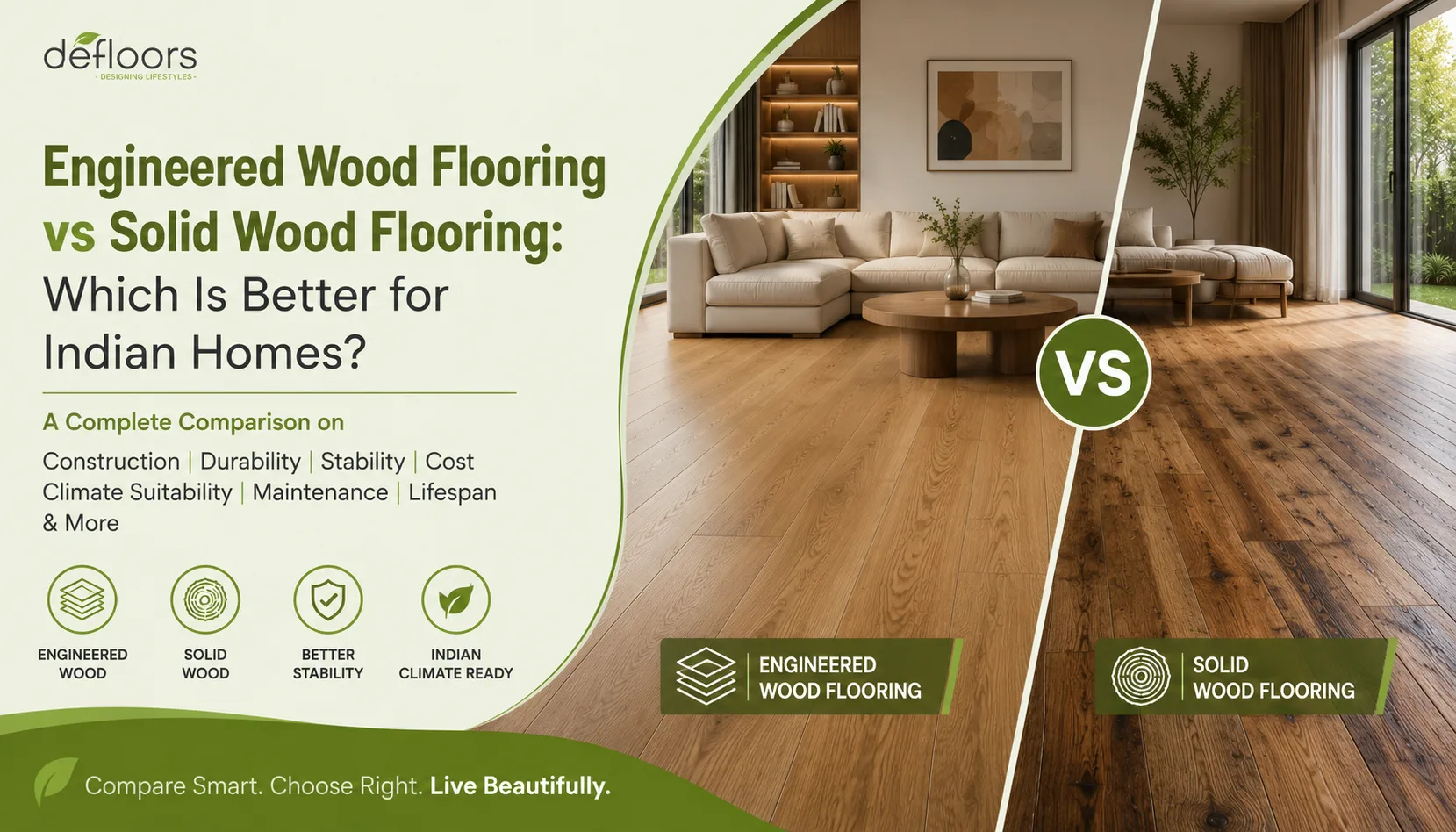
The appeal of a genuine wooden floor is difficult to replicate. Natural grain, warmth underfoot, distinctive textures, and the way wood develops character over time can give a home an elegance that goes beyond short-lived interior trends.
But once homeowners decide they want real wood, another important decision usually follows: engineered wood flooring or solid wood flooring which one should you choose?
At first glance, the two can look remarkably similar. Both can offer an authentic hardwood surface, sophisticated finishes, and the premium character expected from natural wooden flooring. Their real differences become apparent beneath the surface.
Solid wood flooring is made from a single piece of timber, whereas engineered wood flooring combines a genuine hardwood top layer with a carefully constructed multi-layer core. That structural difference influences how each floor responds to humidity, temperature changes, installation conditions, maintenance, and years of everyday use.
These considerations become particularly important when choosing wooden flooring for Indian homes. From intense summers and monsoon humidity to dry winters and continuously air-conditioned interiors, Indian properties can expose natural materials to substantial environmental variations.
So, the question is not simply which flooring is “better.”
The more useful question is:
Which flooring construction is better suited to your home, climate, lifestyle, design expectations, and long-term priorities?
This detailed comparison of engineered wood flooring vs solid wood flooring examines exactly that, helping homeowners make a decision based on performance and long-term value rather than appearance alone.
Engineered Wood Flooring vs Solid Wood Flooring: Quick Answer
Both engineered and solid wood flooring are genuine wood flooring solutions, but their construction makes them suitable for different requirements.
Solid wood flooring is manufactured from a single piece of natural timber. It provides traditional hardwood construction, exceptional authenticity, and considerable refinishing potential when the plank thickness and condition allow.
Engineered wood flooring, on the other hand, uses a genuine hardwood wear layer over a multi-layer engineered core. This construction provides the appearance and character of real hardwood while improving dimensional stability and reducing the extent to which the floor responds to environmental fluctuations.
For many contemporary Indian homes, especially properties in locations experiencing considerable seasonal temperature and humidity variations, high-quality engineered flooring can provide a more practical balance of authentic wood aesthetics, stability, installation flexibility, and long-term performance.
That does not make solid wood an inferior flooring material. In the right environment and with appropriate installation and maintenance, solid hardwood flooring remains an exceptional premium choice.
The decision ultimately depends on the property and how the flooring is expected to perform within it.
| Factor | Engineered Wood Flooring | Solid Wood Flooring |
|---|---|---|
| Construction | Real hardwood top layer over an engineered multi-layer core | Single piece of natural hardwood |
| Real Wood | ✔ Yes | ✔ Yes |
| Natural Appearance | Authentic hardwood appearance | Authentic hardwood appearance |
| Dimensional Stability | Generally higher | More responsive to environmental changes |
| Expansion & Contraction | Reduced due to engineered construction | Naturally more pronounced |
| Indian Climate Suitability | Well suited when correctly specified and installed | Suitable where environmental conditions are properly managed |
| Installation Flexibility | Greater | More dependent on site and subfloor conditions |
| Refinishing | Possible depending on wear layer | Usually offers greater refinishing potential |
| Maintenance | Manageable with correct care | Requires appropriate hardwood care |
| Lifespan | Can last decades with quality construction and care | Can last for generations under suitable conditions |
| Design Options | Extensive species, finishes, dimensions and patterns | Extensive natural hardwood options |
| Best Suited For | Modern homes requiring real wood with greater stability | Buyers prioritising traditional solid timber construction |
| Overall Indian Home Practicality | Excellent for many contemporary properties | Excellent in appropriately controlled and prepared environments |
The comparison makes one thing immediately clear: both are premium flooring categories.
The decision should therefore not be reduced to “real wood versus artificial flooring.” Engineered flooring itself uses real hardwood. Instead, buyers should compare how the two different constructions behave after installation.
What Is Engineered Wood Flooring?
Engineered wood flooring is a real wood flooring system constructed from multiple layers.
Its visible surface consists of genuine hardwood, which may include species such as oak, walnut, ash, or other selected woods. Beneath this surface is an engineered core designed to improve the structural stability of the plank.
The layers within the core are typically arranged in opposing directions. This cross-layer construction helps counteract some of the natural movement associated with timber as surrounding temperature and moisture conditions change.
This construction is precisely what differentiates engineered hardwood flooring from a conventional solid timber plank.
From an aesthetic perspective, high-quality engineered flooring does not have to look like a substitute for solid wood. Because the surface itself is genuine hardwood, it retains natural characteristics such as grain variation, knots, tonal differences, and texture.
The engineering is primarily beneath what you see.
Must Read: Complete Guide to Engineered Wood Flooring
Why Has Engineered Flooring Become So Popular?
Modern properties place increasingly complex demands on flooring.
Homeowners want genuine wood, but they also expect:
- Greater stability
- Design flexibility
- Practical installation
- Long service life
- Compatibility with contemporary construction
Engineered flooring was developed to address this balance.
This is particularly relevant to engineered wood flooring in India, where the same home can experience considerable seasonal environmental changes throughout the year.
Premium engineered flooring therefore appeals not only to homeowners but also to architects and interior designers looking for a real-wood surface that can work effectively within modern project conditions.
What Is Solid Wood Flooring?
Solid wood flooring is manufactured from a single piece of natural timber.
Unlike an engineered plank, there is no separate wear layer and engineered core. The entire thickness of the flooring plank consists of hardwood.
This traditional construction is one of solid flooring’s greatest attractions.
Every plank represents a substantial piece of natural timber, giving the floor the authenticity, character, and longevity for which hardwood floors have been valued for generations.
Depending on the species, dimensions, finish, and installation, solid wood can create exceptionally sophisticated interiors.
Why Do Homeowners Still Choose Solid Wood?
Despite the evolution of engineered flooring technology, solid wood remains highly desirable.
Its appeal includes:
- Traditional hardwood construction
- Genuine natural character
- Excellent longevity
- Considerable refinishing potential
- Timeless visual appeal
For buyers who place particular importance on having a single-piece hardwood plank and whose property conditions support its installation, solid wood can be an outstanding investment.
However, its natural construction also means it responds more directly to surrounding environmental changes.
And that is where the comparison becomes particularly important for Indian properties.
1. Construction: How Are They Different?
Construction is the fundamental difference between engineered and solid wood flooring.
Understanding this difference makes almost every other comparison stability, climate performance, installation and refinishing, much easier to understand.
Solid Wood Construction
A solid wood plank is milled from a single piece of timber.
This means the natural characteristics of the wood continue throughout the thickness of the plank.
The construction is simple, traditional, and highly desirable.
However, wood is naturally hygroscopic. In practical terms, this means it interacts with moisture in the surrounding environment. As environmental conditions change, the moisture content within wood can change as well.
That can result in dimensional movement.
Engineered Wood Construction
An engineered plank approaches the same challenge differently.
Instead of relying on one thick piece of timber, it combines a genuine hardwood surface with an engineered supporting structure.
The multi-directional core is designed to restrict excessive dimensional movement.
It does not mean engineered flooring becomes completely unaffected by moisture or temperature. It is still a wood-based product and must be specified, installed, and maintained appropriately.
What the construction does provide is greater dimensional stability compared with a comparable solid wood plank.
Why This Difference Matters in a Home
Imagine a wooden plank naturally wanting to expand slightly in one direction as environmental moisture increases.
A solid plank responds as one continuous piece of wood.
In a quality engineered plank, the layers beneath the hardwood surface run in different directions and help counterbalance that movement.
That seemingly invisible structural difference can become highly important after years of seasonal changes.
This is why buyers should never compare these products based on surface appearance alone.
2. Appearance and Natural Wood Character
One of the most persistent misconceptions about this comparison is that solid wood looks “real” while engineered flooring looks artificial.
That is not an accurate comparison.
Quality engineered flooring has a genuine hardwood surface.
Consequently, both flooring types can display natural characteristics such as:
- Grain variations
- Knots
- Tonal differences
- Organic textures
- Species-specific character
If two products use the same hardwood species and similar surface treatments, the visual difference after installation may be far less obvious than many buyers expect.
Where Solid Wood Has an Advantage
For buyers who value the knowledge that the entire plank consists of one piece of hardwood, solid wood offers something engineered construction inherently cannot replicate.
That traditional material authenticity can be important in heritage properties, highly traditional interiors, or projects where solid timber itself is part of the design philosophy.
Where Engineered Wood Has an Advantage
Engineered construction provides manufacturers with greater flexibility in developing contemporary formats while still retaining a genuine wood surface.
Premium collections can offer:
- Wider planks
- Longer boards
- Contemporary textures
- Sophisticated surface treatments
- Herringbone configurations
- Chevron patterns
For many modern homes, this provides significant architectural flexibility.
Which Looks More Premium?
Neither construction automatically determines whether a floor looks premium.
Wood species, grading, plank dimensions, surface treatment, manufacturing quality, installation craftsmanship, and the broader interior design have a far greater influence.
A premium engineered oak floor can look considerably more sophisticated than a poorly selected or poorly finished solid wood floor, and the reverse can also be true.
The quality of the product matters more than the label alone.
3. Stability and Expansion: Which Performs Better?
This is arguably the most important functional difference between the two.
Natural timber responds to environmental moisture.
As moisture levels increase or decrease, wood can expand or contract. The extent of movement depends on multiple factors, including species, plank dimensions, installation conditions, indoor environment, and construction.
How Solid Wood Responds
Because solid flooring consists of one continuous piece of timber, environmental changes can influence the entire plank.
If conditions are not properly managed, excessive movement may contribute to problems such as:
- Gapping
- Cupping
- Crowning
- Dimensional changes
These issues are not inevitable. Correct product selection, acclimatisation, moisture assessment, installation, and environmental management can significantly reduce risks.
Nevertheless, solid timber naturally has greater potential for dimensional movement.
How Engineered Wood Responds
Engineered construction is specifically designed to improve dimensional stability.
The cross-layered core helps counterbalance natural wood movement, allowing the plank to remain more stable as environmental conditions fluctuate.
This is one of the strongest practical advantages of engineered flooring.
Does Engineered Flooring Never Expand or Contract?
No.
That would be an unrealistic claim.
Engineered wood remains a wood-based flooring product. Appropriate expansion provisions, subfloor assessment, moisture management, and professional installation are still essential.
The important distinction is that its construction is designed to reduce the extent of dimensional movement, not eliminate the natural behaviour of wood altogether.
That distinction is particularly important when evaluating flooring for India’s changing seasonal conditions.
4. Indian Climate Suitability: Which Flooring Handles It Better?
The question of climate is where a generic international comparison becomes insufficient for an Indian buyer.
India does not have one uniform climate. Conditions vary considerably between regions, seasons, and even indoor environments.
For Defloors‘ core markets across Delhi NCR, flooring may have to cope with intense summer heat, monsoon humidity, cooler winters, and extended periods of indoor air conditioning.
This makes environmental stability an important part of determining the best wooden flooring for Indian homes.
You can visit us for wooden flooring in India.
Delhi NCR’s Seasonal Conditions
Delhi, Gurgaon, Noida, Greater Noida, Faridabad, and Ghaziabad experience substantial seasonal variations.
A home may move through:
- Very hot and dry summer conditions
- Humid monsoon periods
- Cooler and comparatively dry winters
- Mechanically cooled indoor conditions
Natural wood responds to changes in its immediate indoor environment rather than simply the outdoor temperature shown in a weather forecast.
This is why site conditions matter.
Engineered Wood in Delhi NCR
The layered construction of engineered flooring gives it an advantage where dimensional stability is a major priority.
For modern apartments, villas, penthouses, and premium residential projects with changing indoor conditions, engineered flooring can therefore provide a particularly practical solution.
Solid Wood in Delhi NCR
Solid wood can also be installed successfully, but product selection and environmental management become especially important.
Appropriate moisture assessment, acclimatisation, subfloor preparation, expansion allowances, and professional installation should not be treated as optional details.
For buyers who want solid timber, the property needs to be evaluated accordingly.
Humidity and Monsoon Considerations
The monsoon introduces another important variable: humidity.
Wood naturally exchanges moisture with the surrounding air. As relative humidity changes, so can the moisture content of timber.
The engineered structure helps reduce the dimensional consequences of these fluctuations.
This does not make engineered flooring waterproof.
That distinction is essential.
Water resistance, moisture stability, and waterproofing are not interchangeable terms. Buyers should be cautious when these concepts are presented as if they mean the same thing.
Neither conventional solid hardwood nor genuine engineered wood flooring should be selected on the assumption that standing water is harmless.
Instead, the advantage of engineered construction lies primarily in dimensional stability under normal environmental fluctuations.
What About Air-Conditioned Indian Homes?
Air conditioning adds another layer to the discussion.
Modern homes may remain air-conditioned for substantial periods during summer, while windows and doors may be opened more frequently during other seasons.
This creates changing indoor environmental conditions even within the same property.
Engineered flooring’s construction generally makes it more forgiving of such variations.
For this reason, architects and homeowners often favour engineered flooring for contemporary climate-controlled residences.
So, Which Is Better for the Indian Climate?
There is no responsible answer that says solid wood cannot work in India.
It can.
However, if the priority is greater dimensional stability across changing seasonal conditions, engineered wood generally has the advantage.
For many modern Indian properties, this makes high-quality engineered flooring the more practical real-wood solution without requiring homeowners to sacrifice the appearance and character of genuine hardwood.
That is a major reason why engineered wood flooring in India has become increasingly relevant to premium residential projects.
5. Durability and Expected Lifespan
A premium wooden floor should be considered a long-term investment.
Both engineered and solid wood flooring can provide decades of service when the product is high quality, correctly installed, appropriately maintained, and used under suitable environmental conditions.
However, durability should not be confused with thickness alone.
Solid Wood Flooring Lifespan
One of solid wood’s strongest advantages is its substantial hardwood construction.
A high-quality solid floor can last for generations under appropriate conditions.
Because there is considerable timber above the tongue-and-groove profile in many solid flooring products, the surface may also be refinished multiple times over its usable life, depending on the plank construction and condition.
This gives solid wood exceptional restoration potential.
Engineered Wood Flooring Lifespan
Premium engineered flooring can also have a very long service life.
Its longevity depends considerably on:
- Wear layer thickness
- Core quality
- Manufacturing quality
- Surface finish
- Installation
- Maintenance
- Usage conditions
A high-quality engineered product should therefore not be viewed as temporary flooring.
With appropriate selection and care, it can remain part of a property for decades.
Which Is More Durable?
There is no meaningful answer based purely on the words “engineered” and “solid.”
A premium engineered product can outperform a low-quality solid wood product in several practical respects.
Similarly, a high-quality solid hardwood floor installed under ideal conditions can deliver extraordinary longevity.
Buyers should compare the actual specifications and intended application, not merely the flooring category.
6. Refinishing Potential: Where Solid Wood Has an Advantage
Refinishing is one category where solid wood generally holds a clear advantage.
Because a solid plank contains hardwood throughout most or all of its thickness, it typically provides greater scope for sanding and refinishing during its service life.
This can allow an ageing floor to be restored rather than replaced.
Can Engineered Wood Flooring Be Refinished?
Yes, certain engineered floors can be refinished.
But the answer depends heavily on the thickness of the genuine hardwood wear layer.
A premium engineered product with a substantial wear layer may allow refinishing, whereas a product with a very thin surface layer may have limited or no sanding potential.
This is exactly why wear layer thickness should be discussed before purchasing.
Does Everyone Need Multiple Refinishes?
Not necessarily.
Modern surface finishes and appropriate maintenance can help floors remain attractive for many years.
Many homeowners may never need the multiple refinishing cycles theoretically available from solid wood.
Therefore, refinishing potential should be considered alongside your expected ownership period, usage conditions, finish quality, and long-term plans for the property.
The Comparison So Far: What Should Indian Homeowners Take Away?
At this stage, the distinction is becoming clearer.
Solid wood flooring excels when traditional single-piece hardwood construction, exceptional longevity, and maximum refinishing potential are the priorities.
Engineered wood flooring excels when homeowners want genuine hardwood aesthetics combined with improved dimensional stability and greater adaptability to contemporary building conditions.
For Indian homes, particularly across Delhi NCR, the climate and indoor environment can make the stability advantage of engineered construction especially relevant.
But installation, maintenance, cost, room suitability, family lifestyle, and long-term ownership value can change the final decision considerably.
7. Installation Requirements: Engineered Wood Flooring vs Solid Wood Flooring
Installation is one of the areas where the differences between engineered and solid wood become especially practical.
A flooring product can be beautifully manufactured and made from premium timber, but its long-term performance will still depend heavily on how well it is installed.
For Indian homes, installation planning should begin before the flooring is purchased, not after the material reaches the property.
Site conditions, subfloor type, moisture levels, room dimensions, product specifications, and the recommended installation method should all be evaluated in advance.
Engineered Wood Flooring Installation
One of the advantages of engineered flooring is its installation flexibility.
Depending on the specific product and site requirements, engineered wood flooring installation may use methods such as floating, glue-down, or suitable locking systems.
This flexibility can make engineered flooring easier to integrate into different types of residential projects, including new construction as well as renovations.
However, “easier to install” should never be interpreted as “installation quality does not matter.”
Professional installers should still assess the condition of the subfloor, environmental conditions, moisture levels, expansion requirements, plank direction, transitions, and manufacturer recommendations.
Subfloor Preparation Still Matters
The engineered construction of the flooring cannot compensate for a badly prepared base.
The subfloor should generally be clean, dry, structurally stable, and sufficiently level for the specified flooring system.
An uneven base can contribute to movement, unwanted sounds, poor joint performance, or an inconsistent finished surface.
For this reason, site inspection should be treated as part of the flooring system rather than as a separate construction formality.
Solid Wood Flooring Installation
Solid wood flooring typically demands more careful consideration of site and environmental conditions because the entire plank consists of natural timber.
Depending on the product, installation method, and project, requirements may be more restrictive than those associated with engineered flooring.
Acclimatisation, moisture assessment, expansion provision, subfloor suitability, and installation craftsmanship become particularly important.
The installer must understand how solid timber behaves rather than simply knowing how to lay floorboards.
Which Is Easier to Install?
In general, engineered flooring offers greater installation flexibility.
Solid wood installation can be highly successful, but it often requires stricter site preparation and environmental consideration.
For renovation projects or modern apartments where installation conditions can be more constrained, this flexibility can become a meaningful advantage for engineered flooring.
8. Maintenance Requirements: Which Is Easier to Live With?
Wooden flooring does require appropriate care, but the idea that every real wood floor is extremely difficult to maintain is outdated.
Both engineered and solid wood floors can remain beautiful for years when homeowners follow sensible care practices.
The difference lies more in how each flooring system responds to environmental conditions and long-term wear.
Engineered Wood Flooring Maintenance
Routine engineered wood flooring maintenance is generally straightforward.
Regular dust removal helps prevent small abrasive particles from repeatedly rubbing against the surface. Spills should be addressed promptly, furniture legs should be protected where necessary, and excessive wet cleaning should be avoided.
The specific cleaning method should always follow the recommendations applicable to the floor’s finish.
One advantage of engineered construction is that greater dimensional stability can make the floor more manageable in homes where indoor environmental conditions fluctuate seasonally.
However, it remains genuine wood flooring.
Using excessive water or assuming that “engineered” means waterproof can unnecessarily shorten the life of the floor.
Solid Wood Flooring Maintenance
Solid wood flooring maintenance follows many of the same basic principles.
Regular cleaning, spill management, furniture protection, and appropriate cleaning products all help preserve the surface.
Where additional attention may become necessary is environmental management.
Because solid timber can respond more noticeably to changing humidity conditions, maintaining an appropriate indoor environment can become more important for long-term dimensional stability.
Which Requires Less Maintenance?
For everyday surface cleaning, the difference may not be dramatic.
Both floors require responsible care.
From a broader ownership perspective, however, engineered flooring’s dimensional stability can make it more practical for many contemporary Indian homes.
Solid wood compensates with its excellent restoration potential. If the floor eventually becomes worn, its greater refinishing capacity can be a considerable long-term advantage.
9. Engineered Wood Flooring Cost vs Solid Wood Flooring Cost
Cost is understandably important, but comparing these flooring types based solely on an initial per-unit price can be misleading.
There is no single universal engineered wood flooring cost, just as there is no fixed solid wood flooring cost.
Pricing can vary substantially according to the product being selected.
Factors include wood species, grade, plank dimensions, construction quality, surface treatment, origin, installation method, design pattern, and project complexity.
What Influences Engineered Wood Flooring Cost?
For engineered flooring, major cost variables can include:
- Hardwood wear layer species and thickness
- Core construction
- Overall plank thickness
- Width and length
- Surface finishing
- Manufacturing quality
- Imported collection specifications
- Installation requirements
Premium engineered flooring should therefore not automatically be treated as a lower-cost substitute for solid wood.
High-end engineered products can themselves represent a significant premium flooring investment.
What Influences Solid Wood Flooring Cost?
Solid wood pricing is influenced by factors such as:
- Hardwood species
- Timber grade
- Plank dimensions
- Availability of the species
- Surface finish
- Manufacturing quality
- Installation complexity
Because each plank uses a considerably larger volume of the selected hardwood, material economics can also differ from engineered construction.
Which Is More Cost-Effective?
Instead of asking only which one costs less at purchase, homeowners should consider total ownership value.
Think about:
- Expected lifespan
- Installation requirements
- Maintenance
- Refinishing potential
- Environmental suitability
- Possibility of future repairs
- Long-term design relevance
A floor that costs less initially but is poorly suited to the property may offer worse value than a higher-quality floor selected correctly from the beginning.
Likewise, paying more does not automatically guarantee that a product is the right choice.
The objective is not to buy the most expensive floor.
It is to invest in the flooring that provides the best combination of quality, suitability, aesthetics, and long-term performance for the project.
10. Which Flooring Is Better for Different Areas of Your Home?
Another mistake is assuming that the same comparison applies identically to every room.
The way a space is used can influence which characteristics deserve the most attention.
Living Rooms
Living rooms often combine high visual importance with regular foot traffic.
Both engineered and solid wood can create exceptional living spaces.
Solid wood provides traditional hardwood character, while engineered flooring offers the same genuine wood aesthetic with greater dimensional stability.
For large contemporary living areas, premium engineered flooring can also provide access to wide and long plank formats that create strong visual continuity.
In Delhi NCR homes where seasonal environmental changes are an important consideration, engineered flooring may offer the more practical balance.
Bedrooms
Bedrooms generally experience less foot traffic than living areas, allowing greater flexibility.
Both flooring types work exceptionally well.
Natural wood also brings warmth to a bedroom that many harder surfaces struggle to replicate.
Here, the decision may depend more heavily on design preferences, plank format, long-term ownership plans, and the overall flooring strategy across the home.
Dining Areas
Dining spaces require slightly greater attention to surface care because chair movement and occasional spills are part of normal use.
Either flooring can work, provided the selected finish is appropriate and spills are managed promptly.
For active family homes, the finish quality may matter just as much as whether the plank is engineered or solid.
Home Offices
Real wood can create a sophisticated and professional atmosphere in a home office.
Engineered flooring works particularly well where buyers want premium aesthetics alongside practical stability.
If office chairs are used, suitable protection should be considered regardless of flooring construction to reduce concentrated surface wear.
Luxury Residences and Villas
This is where simplistic comparisons become particularly misleading.
Luxury does not automatically mean solid wood.
Today’s premium residences increasingly use sophisticated engineered wood collections because architects value wider formats, contemporary finishes, pattern options, and dimensional stability.
At the same time, solid wood remains highly appropriate for projects where traditional craftsmanship and substantial natural timber are central to the design concept.
For a luxury property, the better question is not:
“Which flooring sounds more premium?”
It is:
“Which flooring best supports the architecture, environmental conditions, design language, and expected use of the property?”
11. Which Is Better for Apartments?
For many modern apartments, engineered wood flooring has several practical advantages.
Apartments may present restrictions related to:
- Existing subfloors
- Floor height
- Installation access
- Renovation timelines
- Acoustic requirements
- Building-specific conditions
The installation flexibility and dimensional stability of engineered flooring can make it particularly attractive in these situations.
That does not mean solid wood cannot be installed in apartments. Rather, site conditions need to be evaluated more carefully before specifying it.
For homeowners renovating premium apartments in Gurgaon, Noida, Delhi, or other urban markets, professional site assessment can help determine which system is technically appropriate before aesthetic decisions are finalized.
12. Which Is Better for Luxury Homes?
Both.
But for different reasons.
Solid hardwood flooring appeals to homeowners who value traditional construction, substantial natural timber, long-term refinishing potential, and the heritage associated with genuine solid hardwood.
Premium engineered flooring appeals to those seeking genuine hardwood alongside greater stability, contemporary plank formats, design flexibility, and compatibility with modern residential construction.
This distinction is particularly important because describing engineered flooring as the “budget version” of solid wood would be inaccurate.
Some of the world’s sophisticated residential interiors use premium engineered flooring precisely because of its technical and architectural advantages.
Therefore, luxury should be evaluated through:
- Material quality
- Wood selection
- Manufacturing standards
- Surface craftsmanship
- Design
- Installation quality
not construction terminology alone.
13. Which Is Better for Homes With Children and Pets?
Family lifestyle should always influence flooring selection.
Children and pets can increase everyday demands through running, toys, furniture movement, claws, spills, dirt, and more frequent cleaning.
But whether a floor handles these conditions well depends on more than whether it is engineered or solid.
Surface Finish Matters
The quality and type of finish can significantly influence how visible everyday wear becomes.
Matte and textured finishes, for example, may conceal minor marks better than highly reflective surfaces.
Wood Species Matters
Different hardwood species have different characteristics.
Species selection should therefore be considered alongside flooring construction.
Maintenance Habits Matter
Prompt spill cleanup, entrance mats, furniture protection, and sensible cleaning routines can substantially influence long-term appearance.
So Which Should Families Choose?
Engineered flooring’s dimensional stability can provide an advantage for active contemporary households, but buyers should still evaluate the actual product’s surface finish, wear layer, wood species, and specifications.
Solid wood’s future refinishing potential can also be valuable in homes expected to retain the same flooring for several decades.
Once again, the actual product matters more than a category-level assumption.
14. Sustainability and Material Efficiency
Sustainability is becoming an increasingly important consideration in architecture and interior design.
Both flooring categories can form part of a responsible material strategy when timber is sourced appropriately, but their construction uses hardwood differently.
A solid wood plank uses the selected hardwood throughout its thickness.
Engineered flooring concentrates premium hardwood in the visible wear layer while using an engineered structure underneath.
This can allow valuable hardwood resources to be used more efficiently.
Does That Automatically Make Engineered Flooring Sustainable?
Not necessarily.
Sustainability depends on more than material quantity.
Buyers should also consider factors such as responsible sourcing, manufacturing practices, product longevity, adhesives and finishes, transportation, and how long the flooring is expected to remain in use.
A durable floor that remains functional and desirable for decades can offer a very different lifecycle proposition from flooring that requires frequent replacement.
For environmentally conscious projects, product-specific information should therefore be evaluated rather than relying on broad assumptions about either category.
15. Engineered Wood vs Solid Wood: Pros and Cons
After examining the individual factors, the trade-offs become much easier to understand.
| Consideration | Engineered Wood Flooring | Solid Wood Flooring |
|---|---|---|
| Genuine hardwood appearance | ✔ Yes | ✔ Yes |
| Dimensional stability | Major advantage | More natural movement |
| Indian seasonal adaptability | Generally stronger | Requires greater environmental consideration |
| Installation flexibility | Generally higher | More site-dependent |
| Wide contemporary formats | Excellent availability | Product-dependent |
| Refinishing potential | Depends on wear layer | Generally greater |
| Traditional timber construction | No | Major advantage |
| Long-term lifespan | Excellent with quality products | Exceptional under suitable conditions |
| Maintenance | Manageable | Manageable, with environmental care |
| Luxury applications | Excellent | Excellent |
The table reinforces an important point:
There is no universally superior product. There is a more appropriate product for a particular project.
16. How to Decide Which One Is Right for Your Home
Instead of trying to declare one flooring type the winner in every situation, use a decision framework.
Choose Engineered Wood Flooring When…
Engineered flooring is likely to be particularly suitable when dimensional stability is a major priority, the property experiences meaningful seasonal environmental changes, installation flexibility matters, or the design calls for contemporary premium plank formats.
It is also a strong choice for homeowners who want genuine hardwood without relying entirely on the dimensional behaviour of a solid timber plank.
Take a deeper dive if you want to Choose The Right Engineered Wood Flooring.
Consider Solid Wood Flooring When…
Solid wood may be the preferred choice when traditional hardwood construction is a major personal or architectural priority, site conditions are appropriate, environmental management can be maintained, and maximum long-term refinishing potential is valued.
Don’t Decide Based on One Factor
The best decision should consider:
Property + Climate + Lifestyle + Product Quality + Installation + Design + Long-Term Expectations
Removing any one of these factors can lead to an incomplete comparison.
17. Common Mistakes to Avoid When Comparing Engineered and Solid Wood Flooring
Assuming Engineered Wood Is Laminate
This is one of the most significant misconceptions.
Engineered flooring has a genuine hardwood surface. Laminate is a different flooring category with a decorative surface designed to reproduce the appearance of another material.
Confusing the two can distort the entire buying decision.
Assuming Solid Wood Is Always Higher Quality
Construction type does not automatically determine manufacturing quality.
A premium engineered product can offer exceptional materials, craftsmanship, finishing, and performance.
Compare actual specifications rather than category labels.
Ignoring Wear Layer Thickness
When evaluating engineered flooring, buyers should understand the hardwood wear layer because it affects longevity and potential refinishing.
Ignoring Indoor Climate
Outdoor climate receives considerable attention, but the environment inside the home is what directly surrounds the floor.
Air conditioning, ventilation, seasonal humidity, and everyday usage all matter.
Choosing on Price Alone
The lowest initial quotation does not necessarily represent the lowest long-term cost.
Likewise, the most expensive option is not automatically the most appropriate.
Treating Installation as an Afterthought
The flooring and installation should be considered as one complete system.
A premium floor installed incorrectly can deliver disappointing results.
18. Why Defloors Recommends Choosing Flooring Based on the Project, Not Just the Product
With flooring, there is rarely a responsible one-size-fits-all recommendation.
A homeowner in a premium Gurgaon apartment may have very different site conditions from someone designing a villa in Delhi. An architect specifying flooring for a large residence may prioritize different plank dimensions, patterns, and installation methods from a homeowner renovating one bedroom.
This is why Defloors’ approach is better understood as project-based flooring selection.
Since 2013, Defloors has worked with homeowners, architects, interior designers, builders, and developers across different types of residential and commercial projects. Backed by more than 17 years of industry knowledge at the leadership level, the emphasis is on understanding the property and project requirements before recommending a flooring solution.
As one of India’s leading importers of premium wooden flooring, Defloors provides access to international flooring collections while considering the practical requirements of Indian properties.
That distinction matters when choosing between solid and engineered wood.
Rather than asking which category is universally superior, an experienced flooring consultation should examine the actual conditions in which the floor will be installed.
For buyers considering premium engineered wood flooring or solid hardwood, this project-specific approach can help prevent an expensive decision based purely on showroom appearance.
Final Verdict: Engineered Wood Flooring or Solid Wood Flooring?
After comparing construction, appearance, dimensional stability, climate suitability, durability, installation, maintenance, refinishing, cost, and residential applications, the answer becomes clearer:
There is no universal winner, but engineered wood flooring has practical advantages for many contemporary Indian homes.
Solid wood flooring remains an exceptional premium material. Its single-piece timber construction provides unmatched traditional authenticity, impressive longevity, and greater potential for repeated refinishing. In properties where environmental conditions are appropriate and homeowners value these characteristics, solid hardwood can be an excellent long-term investment.
Engineered wood flooring approaches the requirements of a modern home differently.
Its genuine hardwood surface preserves the warmth, grain, texture, and character expected from natural wooden flooring, while the engineered core provides greater dimensional stability.
That advantage becomes particularly relevant in Indian homes exposed to seasonal changes in temperature and humidity.
For homeowners across Delhi NCR, including Delhi, Gurgaon, Noida, Greater Noida, Faridabad, and Ghaziabad, those environmental variations deserve serious consideration.
But climate should not be the only deciding factor.
The right flooring also depends on how the home is used, whether it is an apartment or villa, the condition of the subfloor, preferred plank dimensions, interior design objectives, maintenance expectations, expected ownership period, and available installation expertise.
The smartest buying decision therefore isn’t:
“Which product is universally better?”
It is:
“Which flooring system is better suited to my particular home?”
For many modern residences, high-quality engineered wood flooring will provide the more practical balance of natural beauty, stability, design flexibility, and long-term performance.
For other projects, particularly where traditional solid timber construction and maximum refinishing potential are central priorities, solid wood may remain the better choice.
That distinction is what an informed flooring decision should be based on.
Choosing Between Engineered and Solid Wood? Get Expert Guidance Before You Decide
A flooring sample can tell you how a product looks.
It cannot tell you everything about how that flooring will perform in your particular property.
Before investing in either engineered or solid wood flooring, factors such as site conditions, subfloor preparation, indoor environment, lifestyle, product construction, and installation requirements should be considered together.
Defloors has been serving homeowners, architects, interior designers, builders, and developers since 2013, bringing premium wooden flooring collections and global flooring trends to Indian projects.
Whether you’re designing a luxury residence, renovating an apartment, or evaluating flooring for a new home, the Defloors team can help you compare your options based on the requirements of the actual project rather than simply choosing one flooring category over another.
Speak with Defloors to discuss your project and find the wooden flooring solution best suited to your space.
Frequently Asked Questions
Yes. Engineered wood flooring has a genuine hardwood surface layer bonded to an engineered multi-layer core. Depending on the collection, the visible layer may be made from oak, walnut, ash, or another hardwood species.
This is fundamentally different from laminate flooring, which typically uses a decorative image layer to reproduce the appearance of wood.
The primary difference is construction.
Solid wood flooring is manufactured from a single piece of natural timber, while engineered wood flooring combines a genuine hardwood wear layer with a multi-layer engineered core.
This construction gives engineered flooring greater dimensional stability, while solid wood generally provides greater refinishing potential because more hardwood is available through the thickness of the plank.
Neither flooring type is universally better.
Engineered wood flooring is generally more suitable where dimensional stability, installation flexibility, and adaptability to changing environmental conditions are priorities.
Solid wood flooring can be an excellent choice where traditional single-piece hardwood construction, exceptional longevity, and greater refinishing potential are more important.
The correct choice depends on the property, climate, lifestyle, product quality, installation conditions, and long-term expectations.
For many contemporary Indian properties, engineered flooring offers a particularly practical combination of real wood aesthetics and dimensional stability.
India’s seasonal temperature and humidity variations can influence natural wood. The multi-layer construction of engineered flooring helps reduce dimensional movement compared with conventional solid timber planks.
However, product quality, installation, subfloor conditions, and indoor environmental management remain important regardless of flooring type.
Yes. Solid wood flooring in India can perform exceptionally well when the right product is selected and site conditions are properly assessed.
Correct acclimatisation, subfloor preparation, moisture assessment, expansion allowances, installation craftsmanship, and environmental management are particularly important.
It would therefore be incorrect to say that solid wood is unsuitable for Indian homes. It simply requires a more careful assessment of the installation environment.
For many properties across Delhi, Gurgaon, Noida, Greater Noida, Faridabad, and Ghaziabad, engineered flooring can offer an advantage because of its greater dimensional stability.
Delhi NCR experiences significant seasonal variations, from intense summer conditions and monsoon humidity to cooler winters and prolonged air-conditioned indoor environments.
Solid wood can also work successfully, but environmental and installation considerations become particularly important.
Yes. Engineered flooring is still a wood-based product and can respond to environmental conditions.
However, its multi-layer construction is designed to reduce dimensional movement compared with a conventional solid timber plank.
This is why appropriate expansion provisions and professional installation remain necessary even with engineered flooring.
Not necessarily.
Durability depends on product quality, hardwood species, surface finish, manufacturing standards, installation, maintenance, traffic, and environmental conditions.
Solid wood generally has an advantage in refinishing potential because of its greater amount of usable hardwood. However, premium engineered flooring can provide decades of service and may offer greater stability in demanding environmental conditions.
Certain engineered floors can be refinished, but the number of times or whether refinishing is advisable at all depends substantially on the thickness of the hardwood wear layer and the product’s construction.
This is why wear layer specifications should be evaluated before purchasing engineered flooring, especially when long-term restoration is an important buying consideration.
Day-to-day care is relatively similar.
Both generally benefit from regular dust removal, appropriate cleaning, prompt spill management, furniture protection, and avoiding excessive water.
Engineered flooring’s greater dimensional stability may make it more practical under changing indoor conditions, while solid wood may require closer attention to environmental management.
Both can be excellent luxury flooring solutions.
Solid wood is particularly appealing when traditional timber construction and long-term refinishing potential are priorities.
Premium engineered wood flooring is widely suited to luxury residences where homeowners and architects want genuine hardwood alongside greater dimensional stability, contemporary plank dimensions, sophisticated finishes, and design flexibility.
The quality of the actual flooring is more important than assuming one construction is automatically more luxurious.
Not always.
Premium engineered flooring can itself represent a substantial investment, particularly when it uses high-quality hardwood, a substantial wear layer, sophisticated finishes, larger plank formats, and premium manufacturing.
Rather than assuming engineered flooring is automatically cheaper, buyers should compare actual product specifications, installation requirements, expected lifespan, maintenance, and long-term value.
Engineered flooring is often particularly suitable for apartments because of its dimensional stability and installation flexibility.
However, the appropriate choice still depends on the existing subfloor, floor-height considerations, product specifications, acoustic requirements, and building conditions.
A professional site assessment should ideally be completed before making the final selection.
There is no single best wooden flooring for Indian homes because requirements differ between properties.
For many modern Indian residences, engineered wood flooring offers an excellent balance of genuine hardwood aesthetics, dimensional stability, installation flexibility, and long-term performance.
Solid wood remains an outstanding alternative where site conditions are suitable and traditional hardwood construction and greater refinishing potential are priorities.
Start by evaluating six factors:
Climate and indoor environment, lifestyle, property type, installation conditions, design expectations, and long-term ownership plans.
Then compare the actual products rather than making the decision based solely on flooring categories.
Wear layer thickness, hardwood species, core construction, plank dimensions, finish quality, warranty, installation requirements, and supplier expertise should all contribute to the final decision.