
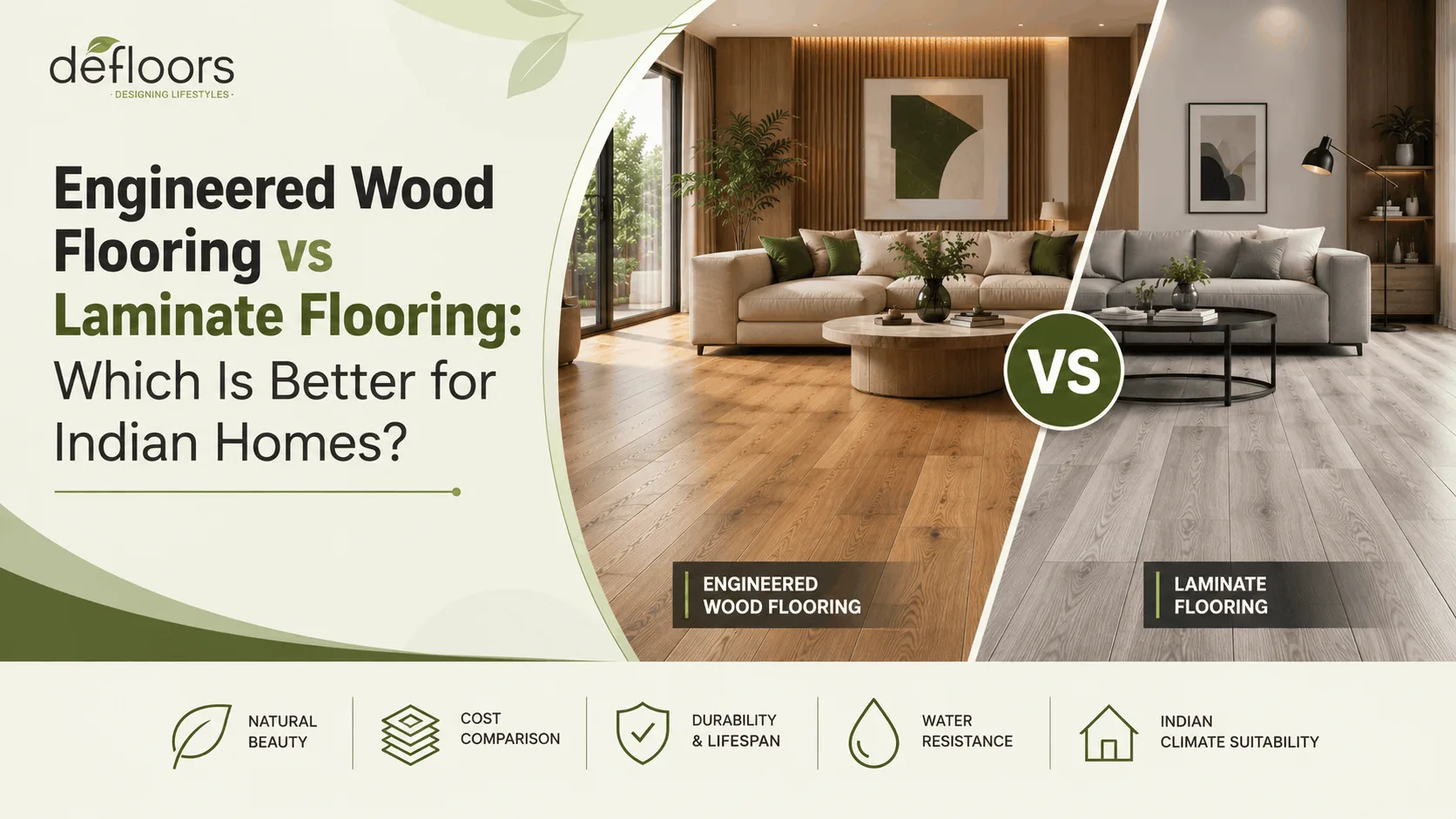
Choosing between engineered wood flooring and laminate flooring can be difficult because both can create the warm appearance of a wooden floor without using traditional solid hardwood construction.
But beneath the surface, they are very different products.
Engineered wood flooring has a real wood surface, while laminate uses a decorative printed layer over a wood-based core. That difference influences everything from appearance and feel to price, scratch resistance, maintenance, longevity and how the floor should be selected for your home.
So, which one should you choose?
The answer is not simply that one is “better”.
Engineered wood is generally the stronger choice when natural wood character, premium aesthetics and long-term value are the priorities. Laminate is often the better option when affordability, easier maintenance and resistance to everyday surface wear matter more.
For Indian homes—particularly apartments and residences across Delhi NCR—the right choice should also consider the room, subfloor condition, expected foot traffic, moisture exposure, interior style and overall project budget.
At DeFloors, we work with both engineered and laminate flooring, so this guide compares them according to where each flooring type actually makes sense.
Quick Comparison: Engineered Wood vs Laminate Flooring
| Factor | Engineered Wood Flooring | Laminate Flooring |
|---|---|---|
| Surface | Real wood veneer | Decorative printed layer |
| Wood appearance | Naturally unique | Manufactured wood appearance |
| Initial investment | Generally higher | Generally lower |
| Scratch resistance | Depends on wood species and finish | Often strong due to protective wear layer |
| Refinishing | Sometimes possible depending on veneer thickness | Cannot normally be refinished |
| Maintenance | Moderate | Relatively easy |
| Moisture | Must be protected from excessive moisture | Varies significantly by product; not automatically waterproof |
| Design character | Natural grain and variation | Wide variety and consistent patterns |
| Best suited to | Premium, long-term interiors | Practical, budget-conscious interiors |
| DeFloors options | Approx. 12–15 mm engineered ranges | 8 mm and 12 mm laminate ranges currently displayed online |
The most important distinction is therefore not merely price.
It is whether you want a real-wood flooring surface or a high-performance wood-look surface.
What Is Engineered Wood Flooring?
Engineered Wood Flooring is genuine wood flooring built using multiple layers rather than a single solid piece of timber.
The National Wood Flooring Association defines engineered flooring as real wood flooring because the top wearable surface consists of real wood. Beneath that surface are additional layers designed to improve dimensional stability.
This construction helps engineered wood expand and contract less than traditional solid wood as environmental conditions change.
At DeFloors, engineered flooring options include configurations around 12–15 mm overall thickness, with factors such as veneer thickness, plank size, core structure and surface finish affecting the suitability of an individual product. DeFloors also offers design options including herringbone, chevron and conventional plank layouts. Defloors
What engineered wood feels like
Because the visible surface is natural wood, engineered flooring retains genuine variations in:
- grain,
- knots,
- colour,
- texture,
- plank character.
No two natural boards need to look exactly alike.
That is one of the main reasons architects and homeowners select engineered wood when the objective is to create a more authentic premium interior.
What Is Laminate Flooring?
Laminate Wood Flooring is a multilayer flooring system designed to recreate the look of materials such as natural wood.
A typical laminate construction includes:
- a protective wear layer;
- a decorative image layer;
- a wood-based core, frequently HDF;
- a stabilising backing layer.
The North American Laminate Flooring Association describes laminate as a wood-based rigid floor covering with a multilayer structure consisting of components such as an overlay, decorative layer, core and backing.
The visible wood grain, therefore, is not a layer of hardwood. It is a high-resolution decorative representation of wood.
This is not necessarily a disadvantage.
It allows laminate manufacturers to create a very broad range of colours and designs while maintaining relatively consistent appearance between boards.
DeFloors currently displays laminate flooring options including 8 mm and 12 mm ranges, intended for residential as well as commercial interiors.
Engineered Wood vs Laminate: What Is the Main Difference?
The simplest answer is:
Engineered wood contains real wood on its visible surface. Laminate reproduces the appearance of wood through a decorative layer over a wood-based core.
This affects almost every other comparison.
Engineered wood tries to preserve the character of natural timber while improving its structural stability.
Laminate is designed differently: its objective is to provide a durable, practical surface that can reproduce the appearance of timber without requiring a real hardwood wear surface.
That is why homeowners should avoid choosing between them based on photographs alone.
The question should be:
What does your room need the floor to do?
1. Appearance: Which Looks More Like Real Wood?
Winner: Engineered wood
If authentic timber appearance is the priority, engineered wood has the advantage because its visible surface actually is wood.
Natural timber has variations that are difficult to reproduce perfectly through printing. Grain direction, knots, subtle colour differences and texture change naturally from plank to plank.
The NWFA specifically distinguishes real wood floors from wood-look products based on the presence of real wood on the wearable surface.
Modern laminate, however, has improved substantially.
High-resolution printing and textured finishes can create convincing oak, walnut and other timber effects. NALFA notes that the decorative layer can recreate a wide variety of natural materials. NALFA
Choose engineered wood when:
- natural grain matters;
- you are creating a premium interior;
- the floor is an important design feature;
- you want variation rather than complete uniformity.
Choose laminate when:
- you want a wooden appearance without paying primarily for real wood;
- you prefer consistent colours and patterns;
- practical performance matters more than natural material authenticity.
2. Cost: Is Laminate Cheaper Than Engineered Wood?
Winner for initial budget: Laminate
Laminate generally requires a lower initial investment than engineered wood.
The reason is straightforward: engineered flooring uses a genuine hardwood wear surface, while laminate uses a manufactured decorative layer.
However, homeowners should not compare flooring only by the per-square-foot material rate.
Your final flooring project can also depend on:
- total floor area;
- subfloor condition;
- levelling requirements;
- flooring thickness;
- installation method;
- underlay;
- skirting and profiles;
- room layout;
- herringbone or chevron patterns;
- wastage;
- site accessibility;
- installation complexity.
This is why DeFloors does not treat every flooring project as having one universal fixed rate.
For Delhi NCR projects, the more reliable approach is to review the site and flooring requirements before finalising the specification and quotation.
You can also read our detailed guide to wooden flooring cost in India before requesting a project-specific quotation.
You can also get an estimate of wooden flooring in Delhi.
3. Durability: Which Flooring Lasts Longer?
Answer: It depends on what you mean by durability.
This is where many flooring comparisons become misleading.
Durability is not one characteristic.
It can mean:
- resistance to scratching;
- resistance to impact;
- resistance to wear;
- dimensional stability;
- moisture performance;
- repairability;
- total usable lifespan.
Laminate has a dedicated wear layer intended to resist abrasion and everyday surface damage. NALFA performance standards evaluate laminate flooring across factors including wear, impact, stains, moisture resistance and dimensional stability.
This can make a good laminate particularly practical in busy homes.
Engineered wood behaves differently.
Its real wood surface may show scratching or wear depending on the species and finish, but some engineered floors can be renewed or refinished if the wear layer is sufficiently thick. The NWFA notes that engineered wood can be sanded and refinished, although generally fewer times than solid hardwood.
So:
Laminate can be better at resisting some types of everyday surface wear.
Engineered wood can offer better long-term restoration potential when its construction allows refinishing.
4. Which Is Better for Homes With Children or Pets?
For a very active household, quality laminate deserves serious consideration.
Children, moving furniture, toys and pets can create repeated abrasion and scratching. A good laminate wear surface is specifically designed to cope with everyday use.
That does not mean engineered flooring is unsuitable.
It means the finish, wood species and expected use should be considered carefully.
For premium living or bedroom spaces where appearance carries more weight, engineered wood may still be preferable.
For heavily used family areas where practicality and budget dominate the decision, laminate may provide a more forgiving solution.
5. Water Resistance: Engineered Wood or Laminate?
Winner: There is no universal winner. Check the actual product specification.
Neither category should automatically be described as waterproof.
This is especially important because “water-resistant” and “waterproof” are not interchangeable terms.
Engineered wood contains real wood and therefore continues to react to environmental moisture.
Laminate also contains a wood-based core, commonly HDF. NALFA even maintains separate test criteria relating to surface swell and water resistance because performance varies between laminate products.
For either flooring type:
- standing water should be dealt with quickly;
- moisture conditions in the substrate matter;
- installation instructions must be followed;
- kitchens and other moisture-prone areas require product-specific evaluation;
- bathrooms and persistently wet environments may require a different flooring system altogether.
If water exposure is one of your primary concerns, DeFloors can also help compare these options against SPC Flooring or other waterproof flooring solutions rather than forcing either engineered wood or laminate into an unsuitable application.
6. Which Is Better for Delhi NCR Weather?
This requires more nuance than saying one product is simply “good for Indian climate”.
Delhi NCR experiences substantial seasonal variation—from hot summers and monsoon humidity to comparatively dry winters.
Real wood remains hygroscopic, which means it reacts to moisture in the surrounding environment. The NWFA notes that wood can gain moisture and swell in humid conditions and lose moisture and shrink in dry conditions.
Engineered wood’s layered construction helps reduce movement compared with solid wood, which is one of its important advantages.
Laminate flooring also requires proper moisture management because its core remains wood-based.
For Delhi NCR homes, the bigger practical questions are therefore:
- Is the subfloor dry?
- Is the concrete properly prepared?
- Has the selected flooring been stored and handled correctly?
- Is the correct underlay or moisture barrier being used?
- Has sufficient perimeter expansion allowance been provided?
- Is indoor moisture reasonably controlled?
Installation quality can therefore matter almost as much as flooring category.
7. Which Is Easier to Maintain?
Winner: Laminate for routine simplicity
Laminate usually requires less intervention during everyday ownership.
Regular vacuuming or sweeping and appropriate damp cleaning are generally enough, subject to the flooring manufacturer’s instructions.
Engineered wood is also relatively straightforward to maintain but should be treated as a real wood surface.
That means avoiding:
- excessive standing water;
- aggressive cleaning chemicals;
- abrasive cleaning;
- dragging furniture directly across the floor.
Engineered wood owners should also expect natural changes in the floor over time. For many homeowners, that ageing is part of real wood’s appeal.
8. Which Feels Better Underfoot?
Usually: Engineered wood
The real timber surface gives engineered flooring the warmth and tactile character many buyers associate with wooden interiors.
Laminate can still be comfortable—particularly when used with an appropriate underlay—but the experience is different because the surface is manufactured rather than timber.
Underlay also affects:
- acoustic performance;
- footfall noise;
- thermal feel;
- minor subfloor irregularities.
NALFA describes underlayment as serving purposes including acoustic and thermal insulation, moisture protection and increased comfort underfoot.
So do not judge a floating laminate floor only by the plank itself.
The entire installation system matters.
9. Can Engineered Wood Be Refinished? What About Laminate?
Engineered wood: sometimes
Laminate: no
Laminate’s visible wood appearance is part of a printed decorative system. Sanding the floor would destroy that layer.
Engineered flooring uses real wood on the top surface, so certain products can be refinished.
But there is an important qualification:
Not every engineered floor can be sanded the same number of times.
Refinishing potential depends heavily on the thickness of the usable wood layer and flooring construction.
That is why DeFloors The Wooden Flooring Company considers veneer thickness one of the important specifications when selecting engineered flooring.
If future refinishing matters to you, ask about the wear layer before selecting a product rather than assuming that every engineered plank can be repeatedly sanded.
10. Which Flooring Is Better for Different Rooms?
Living Room
Our preference:
Engineered wood for premium homes; laminate for practical high-use homes.
The living room is usually one of the most visually important areas.
Choose engineered wood if natural material character and premium design are priorities.
Choose laminate if the room experiences very heavy family use and easier surface maintenance is more important.
Bedroom
Our preference:
Engineered wood where budget permits.
Bedrooms generally experience less abrasive traffic than entrance areas or family rooms.
This makes them particularly suitable for the warmth and natural visual appeal of engineered wood.
Laminate remains an excellent alternative where the budget needs to cover several rooms.
Children’s Room
Our preference:
Laminate in many households.
Ease of maintenance and a protective surface can make laminate particularly practical where toys, furniture movement and regular cleaning are expected.
Product safety, emissions certifications and actual manufacturer specifications should still be reviewed before selection.
Home Office
Depends on design and chair traffic.
An engineered wood floor can create a premium office environment, while laminate can be useful where rolling chairs and frequent traffic are expected.
Whichever flooring you choose, appropriate chair protection can reduce concentrated surface wear.
Kitchen
Requires individual assessment.
Neither “engineered” nor “laminate” automatically means waterproof.
If spills and persistent moisture exposure are expected, product-specific water performance becomes more important than the category name.
In some kitchens, another solution such as SPC may be more appropriate.
Bathroom
For conventional laminate and engineered wood:
Usually neither is our first recommendation.
Persistent moisture, splashing and standing water create unnecessary risk for wood-based flooring systems.
Use a product specifically designed and warranted for wet environments.
11. What About Installation?
Both systems may use click-lock or floating installation methods depending on the product, while some engineered wood systems may also support alternative installation methods.
But click-lock should not be interpreted as meaning that installation quality does not matter.
A professional flooring installation should evaluate:
- substrate flatness;
- substrate moisture;
- expansion allowances;
- underlay or moisture barrier;
- door clearances;
- transitions;
- room geometry;
- installation direction;
- skirting;
- wastage and cutting.
This is particularly important over concrete subfloors.
DeFloors provides both flooring supply and professional installation, with installation available for DeFloors products and a primary service focus on Delhi NCR.
For projects outside Delhi NCR, availability can be confirmed according to the project location.
Engineered Wood vs Laminate Flooring: Which Should You Choose?
Here is the simplest decision framework.
Choose Engineered Wood Flooring If:
- you want real wood rather than a wood-look surface;
- natural grain and variation matter;
- your interior is positioned toward the premium end;
- you are comfortable with a higher initial investment;
- you want potential refinishing options;
- the floor will remain part of the home for the long term.
Choose Laminate Flooring If:
- budget is a major consideration;
- you need flooring across a large area;
- easy daily maintenance is important;
- scratches and surface wear are a concern;
- you want broad design choice;
- natural timber itself is not essential.
DeFloors Recommendation: Don’t Choose by Category Alone
One of the biggest mistakes homeowners make is asking:
“Which is better: laminate or engineered wood?”
before asking:
“Better for what?”
A premium engineered floor installed in the wrong environment can be a poor decision.
A carefully selected laminate floor installed correctly in the right room can perform extremely well.
Likewise, choosing laminate purely because it costs less may lead to disappointment if what you really wanted was the character and long-term aesthetic of natural timber.
At DeFloors, we recommend evaluating at least six things before making the final selection:
- Room and usage
- Expected foot traffic
- Subfloor condition
- Moisture exposure
- Design expectations
- Project budget
Only after these are understood should the flooring specification be finalised.
Why Consider DeFloors for Engineered or Laminate Flooring?
Established in 2013, DeFloors works with homeowners, architects, builders, interior designers and commercial project teams looking for flooring solutions suited to both design and practical project requirements.
For engineered wood, DeFloors offers options across different thicknesses, plank formats and designs, including conventional planks, herringbone and chevron. Its laminate range similarly provides multiple thickness and finish options for different applications.
More importantly, flooring selection does not need to end with choosing a colour from a catalogue.
For Delhi NCR projects, the DeFloors team can help evaluate the space, recommend appropriate flooring and provide installation using DeFloors products.
Planning a home flooring project? Contact DeFloors for a personalised recommendation and project quotation rather than selecting engineered wood or laminate on appearance alone.
Frequently Asked Questions
Engineered wood is generally better when real wood appearance, natural texture and premium long-term aesthetics are priorities. Laminate can be better when affordability, easy maintenance and everyday wear resistance are more important.
There is no universal winner.
Engineered wood generally costs more because it contains a real hardwood surface. Laminate normally has a lower initial purchase cost.
Actual project pricing also depends on flooring specification, floor area, substrate preparation, installation requirements, pattern and site conditions.
If your objective is authentic natural wood, engineered flooring has an advantage because its top surface is genuine timber.
Modern laminate can nevertheless reproduce wood appearance very convincingly.
Laminate contains wood-based material in its core, but its visible surface is not a hardwood wear layer. The wooden appearance normally comes from a decorative printed layer. NALFA describes laminate as a multilayer wood-based rigid flooring system rather than real wood flooring.
Yes. The National Wood Flooring Association classifies flooring with real wood as its top-most wearable surface as real wood flooring, which includes engineered wood flooring.
Laminate can be a practical choice for active pets because quality products are designed with wear-resistant surfaces. Engineered wood can also work well, but scratches and dents may become more visible depending on the wood species and finish.
No. Laminate should not normally be sanded because the visible design is part of a decorative surface layer.
Some engineered wood flooring can be refinished, but this depends on the thickness and construction of its real wood wear layer. Always confirm the actual specification before purchase.
Both can work when correctly specified and installed.
Engineered wood may be preferable for premium living spaces and bedrooms where real wood is desired. Laminate may be preferable for budget-conscious or heavily used areas.
The condition of the concrete substrate, moisture levels, room use and installation quality should be assessed before deciding.