
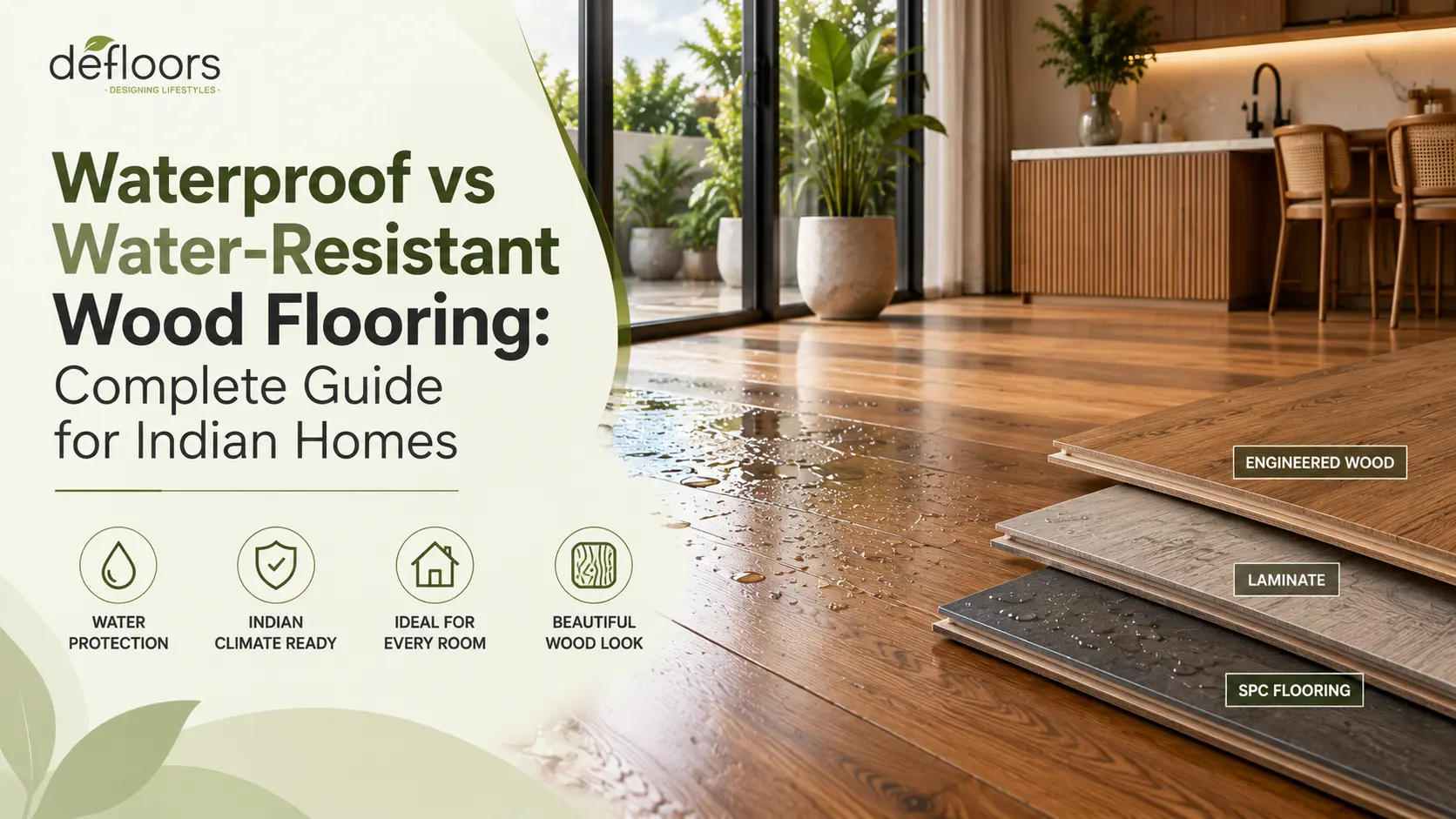
Wood-look flooring has become increasingly popular in Indian homes because it brings warmth, texture and the visual character of timber into modern interiors. But one question becomes especially important before choosing a floor:
What happens when it comes into contact with water?
Terms such as waterproof wood flooring, water-resistant flooring, SPC flooring, waterproof laminate and moisture-resistant wooden flooring are often used interchangeably. They should not be.
A floor that can tolerate an occasional spill is not necessarily suitable for standing water. Likewise, a waterproof flooring material does not automatically make the entire room or installation waterproof.
For Indian homes, this distinction matters even more because flooring may need to cope with monsoon humidity, concrete subfloors, wet cleaning, kitchen spills, bathroom moisture and significant seasonal changes.
At DeFloors, flooring selection starts with the way a space will actually be used. This guide explains the differences between waterproof and water-resistant flooring and compares the main wood and wood-look options available for Indian homes.
What Does Waterproof Wood Flooring Actually Mean?
In practical flooring terminology, waterproof flooring means the flooring material is designed so that ordinary exposure to water does not cause the core to absorb moisture, swell or deform in the way conventional wood-based products can.
However, the phrase “waterproof wood flooring” can be confusing.
Natural timber itself is not completely waterproof. Real wood responds to moisture in its environment. Engineered wood improves stability through layered construction, but it still contains genuine wood.
Many products sold as waterproof wood flooring are therefore actually wood-look floors manufactured from materials such as SPC rather than natural timber.
DeFloors’ dedicated waterproof wooden flooring range uses SPC—Stone Plastic Composite—to create the visual appearance of wood while providing a rigid waterproof core designed for moisture-prone environments.
That makes material construction one of the first things homeowners should check rather than relying only on the words “wooden flooring” in a product name.
Waterproof vs Water-Resistant Flooring: What Is the Difference?
These terms describe different levels of moisture performance.
Waterproof flooring
Waterproof flooring is designed so that its core does not readily absorb water during normal exposure.
SPC is one of the most common examples used for wood-look interiors.
Water-resistant flooring
Water-resistant flooring can tolerate limited moisture or spills but should not be treated as suitable for prolonged standing water.
Engineered wood is a good example.
DeFloors’ engineered wood flooring uses layered construction to improve dimensional stability compared with traditional solid timber, but it is still explicitly considered water-resistant rather than waterproof.
Why the difference matters
Imagine water is spilled in a living room and cleaned within a short period.
A quality water-resistant floor may handle that situation perfectly well.
Now imagine water repeatedly reaches the same floor from:
- a leaking appliance,
- bathroom splashing,
- wet footwear,
- balcony runoff,
- plumbing problems,
- persistent dampness,
- or water trapped below the floor.
That creates a very different exposure condition.
The appropriate flooring should therefore be selected based on the actual moisture risk of the room, not simply on whether the product description contains the word “resistant”.
Which Types of Flooring Can Handle Water?
For homeowners who want the appearance of timber, three commonly considered categories are:
- SPC flooring
- Engineered wood flooring
- Laminate flooring
They can look similar from above, but their construction—and therefore their behaviour around moisture—is very different.
1. SPC Flooring
SPC stands for Stone Plastic Composite or Stone Polymer Composite.
It is a rigid-core flooring system that can reproduce wood, stone and other surface designs while using a highly moisture-resistant composite core rather than a conventional timber core.
For homeowners specifically looking for waterproof wood flooring, SPC is generally the strongest candidate among the three options discussed here.
Key advantages of SPC flooring
SPC can offer:
- strong resistance to water;
- dimensional stability;
- scratch resistance;
- relatively easy maintenance;
- wood-look designs;
- suitability for high-traffic areas;
- click or loose-lay installation depending on the product;
- suitability for both residential and commercial spaces.
Its moisture performance is particularly useful where spills are likely to occur.
Where SPC makes sense
SPC can be considered for:
- kitchens;
- living rooms;
- bedrooms;
- retail spaces;
- offices;
- utility areas;
- some moisture-prone interiors.
However, choosing waterproof flooring does not remove the need for proper subfloor preparation and installation.
Water can still enter around room perimeters, beneath skirting, through poorly sealed transitions or from below the floor.
Waterproof plank does not mean waterproof building.
That distinction is important.
2. Engineered Wood Flooring
Engineered wood is fundamentally different from SPC because its surface consists of real wood.
Rather than using one solid piece of timber throughout the plank, engineered flooring typically combines a natural wood surface with multiple structural layers underneath.
This layered construction improves stability while retaining genuine timber grain and texture.
DeFloors offers engineered wood flooring in several constructions, formats and designs, including traditional plank layouts as well as herringbone and chevron options.
Is engineered wood waterproof?
No.
Engineered wood should generally be treated as water-resistant rather than waterproof.
Its construction can make it more dimensionally stable than traditional solid wood, but the flooring still contains real wood and remains sensitive to prolonged moisture exposure.
It can be an excellent choice for:
- living rooms;
- bedrooms;
- premium apartments;
- lounges;
- offices;
- low-moisture commercial interiors.
It is less suitable for spaces where standing water is expected.
Where engineered wood has the advantage
The major reason to choose engineered wood instead of SPC is not waterproofing.
It is material authenticity.
Because the visible surface is genuine timber, engineered wood gives homeowners:
- natural grain;
- authentic variation;
- genuine wood texture;
- premium interior character;
- potential refinishing possibilities depending on wear-layer thickness.
So the decision is often:
Do you need maximum moisture resistance, or is genuine wood the greater priority?
3. Laminate Flooring
Laminate is another popular wood-look option for Indian homes.
It normally uses an HDF or similar wood-fibre core beneath a decorative printed surface and protective wear layer.
DeFloors’ laminated wood flooring is available in different thicknesses and wood-look designs for residential and commercial interiors.
Is laminate waterproof?
Conventional laminate should not automatically be considered waterproof.
Some modern laminate products are designed with enhanced water resistance, but the product specification needs to be checked carefully.
This is because the HDF core can be vulnerable if significant water penetrates through joints or damaged edges.
Where laminate works well
Laminate remains attractive for:
- bedrooms;
- living spaces;
- offices;
- relatively dry interiors;
- budget-conscious projects;
- areas where scratch resistance and easy maintenance are important.
It can provide excellent value when the room does not have a high risk of repeated water exposure.
If laminate has already been affected by substantial moisture, DeFloors also has a detailed guide on how to dry out laminate flooring.
SPC vs Engineered Wood vs Laminate: Quick Comparison
Feature | SPC Flooring | Engineered Wood | Laminate |
Surface appearance | Wood-look decorative layer | Real wood | Wood-look decorative layer |
Core | Rigid composite core | Layered wood construction | Usually HDF/wood fibre |
Waterproof performance | Strongest of the three | No | Product-dependent |
Water resistance | High | Moderate | Varies |
Real wood surface | No | Yes | No |
Scratch resistance | Generally good | Finish-dependent | Generally good |
Maintenance | Easy | Moderate | Easy |
Premium natural appearance | Good simulation | Excellent | Good simulation |
Wet-area suitability | Better suited | Limited | Limited/product-dependent |
Living room suitability | Yes | Excellent | Yes |
Bedroom suitability | Yes | Excellent | Yes |
There is therefore no universal “best flooring”.
The correct answer depends on the room and the type of performance you need.
Why Waterproof Flooring Matters in Indian Homes
Indian residential conditions can be very different from the controlled environments shown in flooring catalogues.
Monsoon humidity
During the monsoon, indoor humidity can rise significantly.
Wood-based flooring absorbs and releases moisture according to surrounding environmental conditions. That can influence dimensional movement.
This does not automatically make wood flooring unsuitable for India.
It means material selection, acclimatisation and installation become important.
Concrete subfloors
Many Indian homes use concrete slabs.
Before wood or wood-look flooring is installed, the substrate should be sufficiently dry, level and appropriately prepared.
The top surface of a floor might resist water while excessive moisture from the slab below still creates installation problems.
Wet cleaning habits
Indian households often rely on regular mopping.
For water-resistant products, the difference between a damp mop and excessive water can be significant.
Homeowners should therefore follow the maintenance recommendations applicable to the specific flooring product.
Kitchens and utility spaces
Cooking, washing and appliance leaks increase the likelihood of water reaching the floor.
For these spaces, moisture performance should usually receive greater weight than it would in a bedroom.
Which Flooring Is Best for Each Room?
Living Room
For most living rooms, all three categories can potentially work.
Choose engineered wood when genuine timber appearance and premium aesthetics are the priority.
Choose laminate when practicality and budget matter more.
Choose SPC when water resistance and easy maintenance carry greater importance.
DeFloors also has a detailed guide to choosing the best wooden flooring for a living room.
Bedroom
Bedrooms are generally lower-moisture spaces.
That makes engineered wood particularly attractive where warmth, texture and natural material character matter.
Laminate can provide a more economical wood-look alternative, while SPC may suit homeowners who prefer easy maintenance.
Kitchen
The kitchen presents a higher risk of:
- spills;
- wet cleaning;
- appliance leakage;
- moisture around sinks;
- food and liquid exposure.
For that reason, SPC is usually a more practical DeFloors option where waterproof performance is the priority.
Engineered wood should only be considered where moisture exposure is controlled and the selected product is suitable for the intended application.
Bathroom
Bathrooms require extra caution.
Traditional wood-based flooring should not be selected simply because the homeowner wants a timber appearance.
DeFloors has already covered this decision in its guide, Is Wooden Flooring for a Bathroom a Good Idea?.
For environments exposed to regular splashing or standing water, a purpose-designed waterproof system is much safer than assuming engineered wood or conventional laminate will behave like tile.
Even with waterproof SPC, room waterproofing, drainage and installation detailing still matter.
Home Office
Home offices typically have limited moisture exposure.
Here, the decision is usually driven more by:
- appearance;
- chair movement;
- maintenance;
- acoustic requirements;
- budget.
Engineered wood can create a premium professional feel, while laminate and SPC provide durable alternatives for frequently used rooms.
Entrance and High-Traffic Areas
Entrances can experience dust, wet footwear and abrasion.
SPC can be particularly useful where moisture exposure is frequent.
Laminate can also work well where its product rating and moisture performance suit the application.
Engineered wood may be chosen where design value outweighs the need for maximum surface resilience.
Is Waterproof Flooring the Same as Waterproofing a Room?
No.
This is one of the most important distinctions in this guide.
A waterproof floor covering is only one component of a flooring assembly.
It does not automatically protect against:
- plumbing leaks;
- damp concrete;
- water entering through walls;
- failed bathroom waterproofing;
- overflowing drains;
- flooding;
- moisture trapped underneath the floor.
Before installation, the source of any existing dampness should be identified.
Installing waterproof flooring over an unresolved moisture problem can hide the symptom without solving the underlying cause.
What Should You Check Before Buying Waterproof Wood-Look Flooring?
1. Core construction
Do not make the decision from the surface design alone.
Ask what the core is made from.
SPC, HDF laminate and engineered wood behave differently because their underlying structures are different.
2. Room usage
A bedroom and kitchen should not automatically receive the same flooring specification.
Consider:
- moisture;
- traffic;
- furniture movement;
- cleaning;
- sunlight;
- pets;
- children;
- maintenance expectations.
3. Water exposure
Ask whether the floor will face:
- occasional spills;
- frequent splashing;
- wet footwear;
- appliance leakage;
- standing water;
- persistent humidity.
The greater the exposure, the stronger the need for a purpose-designed moisture-resistant system.
4. Subfloor condition
The installation surface should be checked for:
- flatness;
- dampness;
- cracking;
- contamination;
- irregularity.
This becomes especially important over concrete.
5. Installation method
Different flooring products may use click-lock, floating, adhesive or other installation systems.
The correct method depends on the floor construction and manufacturer requirements.
DeFloors offers flooring supply as well as professional installation for its flooring projects, with Delhi NCR as the primary service area.
6. Total project cost
Do not judge flooring only by the material rate per square foot.
Your project may also involve:
- subfloor preparation;
- underlay;
- installation;
- skirting;
- transitions;
- trims;
- wastage;
- pattern complexity;
- floor levelling.
For a broader view, see DeFloors’ guide to wooden flooring cost in India.
Can Waterproof Flooring Look Like Real Wood?
Yes, visually.
Modern wood-look flooring can reproduce:
- oak;
- walnut;
- pale natural wood;
- dark timber;
- rustic textures;
- contemporary grain patterns.
However, a printed wood surface and genuine timber are still different materials.
If authenticity is the priority, engineered wood usually has the advantage.
If moisture resistance is the priority, SPC is generally the more suitable comparison.
That is why material selection should begin with performance requirements first and colour second.
Is Waterproof Flooring Good for Delhi NCR Homes?
It can be particularly useful in Delhi NCR because homes experience a combination of:
- hot summers;
- monsoon humidity;
- comparatively dry winters;
- dust;
- wet cleaning;
- concrete subfloors.
SPC can make sense in spaces where moisture and maintenance are significant concerns.
Engineered wood remains a strong option for premium dry interiors where real timber is preferred.
Laminate can provide a practical balance between appearance, durability and budget in lower-moisture spaces.
Rather than treating one product as universally superior, homeowners should match the flooring construction to the room.
Common Mistakes to Avoid
Assuming all wood-look floors are waterproof
They are not.
SPC, laminate and engineered wood can look similar but have different cores and different moisture behaviour.
Calling engineered wood waterproof
Engineered wood offers better dimensional stability than traditional solid timber, but it still contains real wood.
Treat it as a moisture-sensitive natural-material floor, not as a substitute for a waterproof rigid-core product.
Assuming “waterproof” means no installation precautions
Even waterproof planks require correct substrate preparation, expansion detailing, transitions and perimeter installation.
Ignoring existing dampness
If moisture is entering through the slab or wall, solve the moisture source before covering it with flooring.
Choosing solely by price
The cheapest material is not necessarily the cheapest flooring system over its usable life.
Installation, maintenance, repairs and suitability all matter.
Waterproof Flooring or Real Wood: Which Should You Choose?
Choose SPC waterproof flooring when:
- moisture resistance is a major priority;
- the room has frequent spills;
- easy cleaning matters;
- you want a wood-look finish without a real timber surface;
- the floor will face relatively demanding daily use.
Choose engineered wood flooring when:
- genuine wood is important;
- natural grain and texture matter;
- the space is relatively dry;
- premium interior appearance is a priority;
- you are willing to manage moisture carefully.
Choose laminate flooring when:
- budget is important;
- you want a wide range of wood-look designs;
- the room is relatively dry;
- simple maintenance and scratch resistance matter;
- genuine timber is not essential.
For homeowners comparing the broader flooring landscape, DeFloors’ wooden flooring in India page covers the main product categories available for Indian projects.
Why DeFloors Recommends Choosing by Application, Not by Label
A product does not become the right flooring merely because it is marketed as “premium”, “wooden” or “waterproof”.
The correct flooring is the one whose construction matches:
- the room;
- the substrate;
- moisture conditions;
- expected traffic;
- design objective;
- maintenance expectations;
- project budget.
DeFloors has worked with homeowners, architects, builders, interior designers and commercial projects since 2013, supplying flooring solutions across categories including engineered wood, laminate and waterproof SPC.
For Delhi NCR projects, flooring selection can also be combined with professional installation so that the product and installation system are considered together.
Explore DeFloors’ dedicated waterproof wood flooring range or contact the DeFloors team for a project-specific flooring recommendation.
Frequently Asked Questions
Natural wood flooring should not normally be considered completely waterproof. Real timber reacts to moisture. Products such as SPC create a wood-look finish using a waterproof rigid-core flooring system instead of a genuine wood surface.
Among SPC, conventional laminate and engineered wood, SPC generally provides the strongest protection against water because of its rigid composite core.
The suitability of a particular product should still be checked against its technical specification and intended application.
No. Engineered wood is better described as water-resistant. Its layered construction improves dimensional stability, but the product still contains real wood and should not be exposed to persistent standing water.
Not all laminate is waterproof. Conventional laminate normally contains an HDF or wood-fibre core that can be damaged when significant moisture penetrates the floor.
Some manufacturers offer enhanced water-resistant laminate, so product-specific specifications should always be checked.
SPC can be a practical option for kitchens because it is designed to withstand spills and moisture better than conventional wood-based floors.
Subfloor preparation and correct installation remain important.
A waterproof flooring material may be suitable for certain bathroom applications, but the floor covering itself does not waterproof the entire bathroom. Drainage, substrate waterproofing, joints and installation details must also be appropriate.
There is no single answer for every room. SPC can be advantageous where moisture exposure is high. Engineered wood works well in controlled dry interiors where genuine timber is desired, while laminate can suit lower-moisture spaces where practicality and budget are priorities.
No. SPC is a rigid composite flooring system that can reproduce the appearance of timber, but its visible wood design does not make it genuine hardwood.
Cost depends on the flooring specification, project size, installation requirements, substrate condition and accessories. DeFloors therefore recommends project-specific quotations rather than assuming one fixed price per square foot.
For homeowners who specifically require a waterproof wood-look surface, SPC is generally the most relevant DeFloors category. For areas where natural wood appearance is more important than waterproof performance, engineered wood may be the better choice.